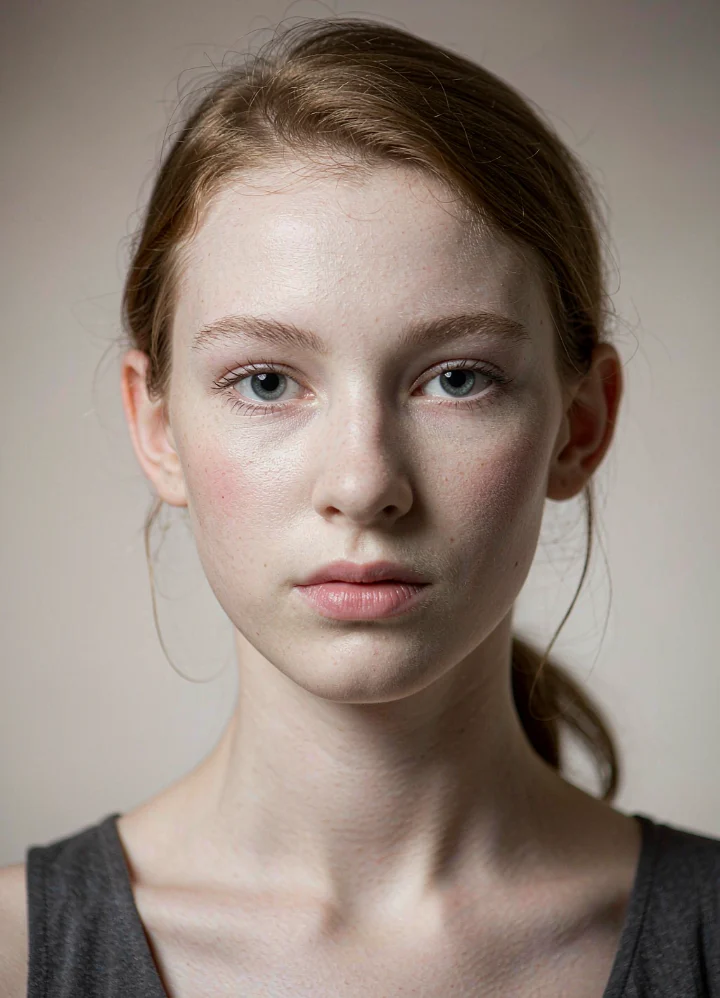
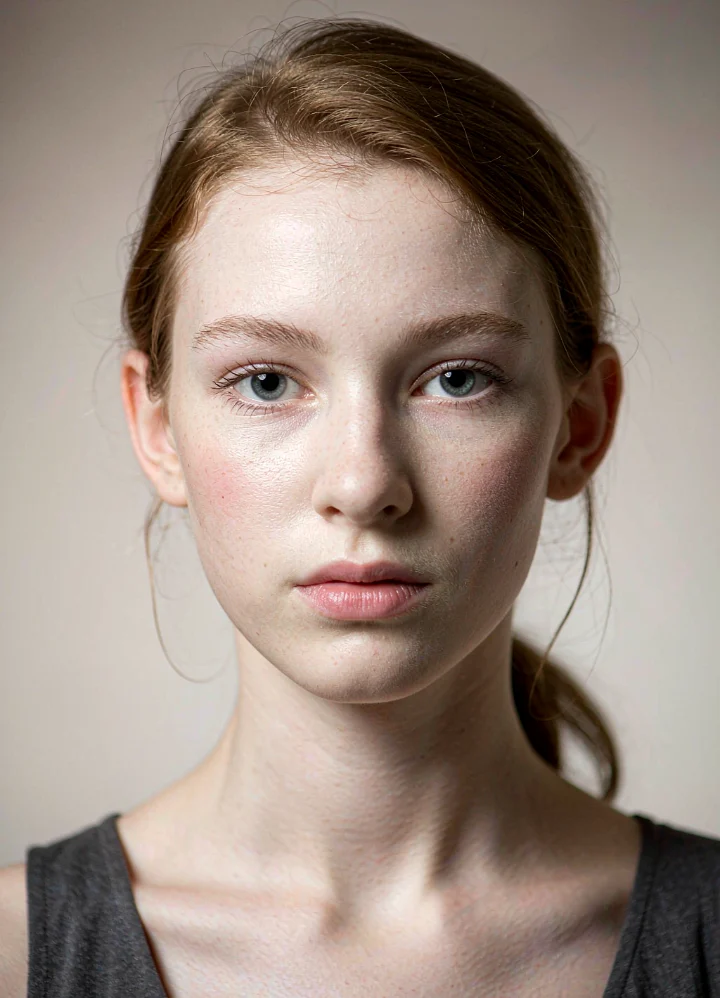
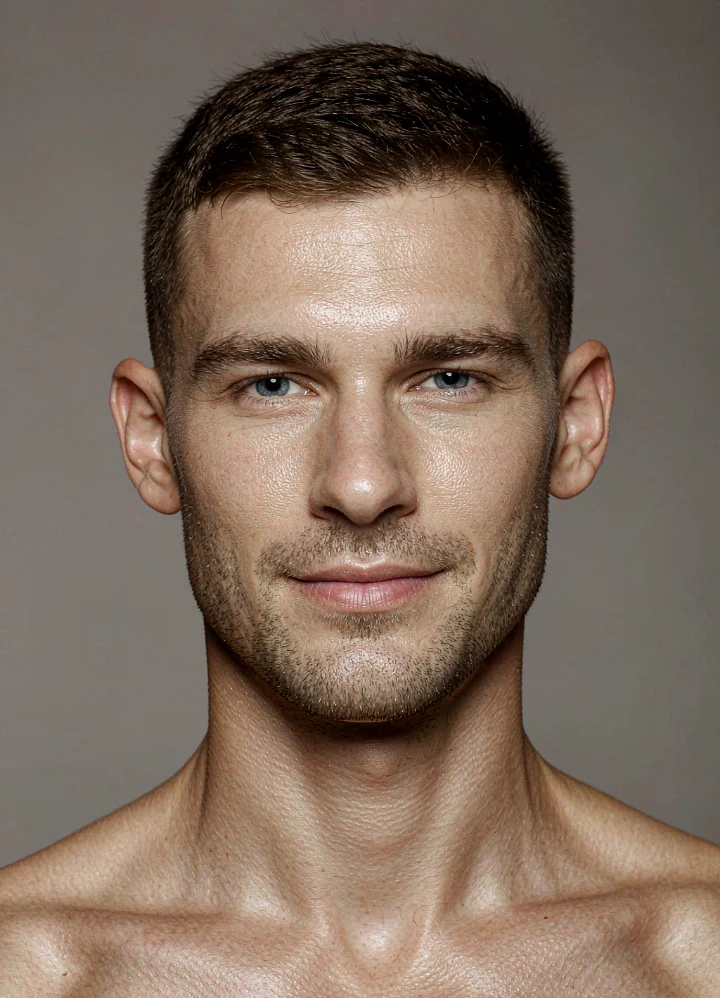
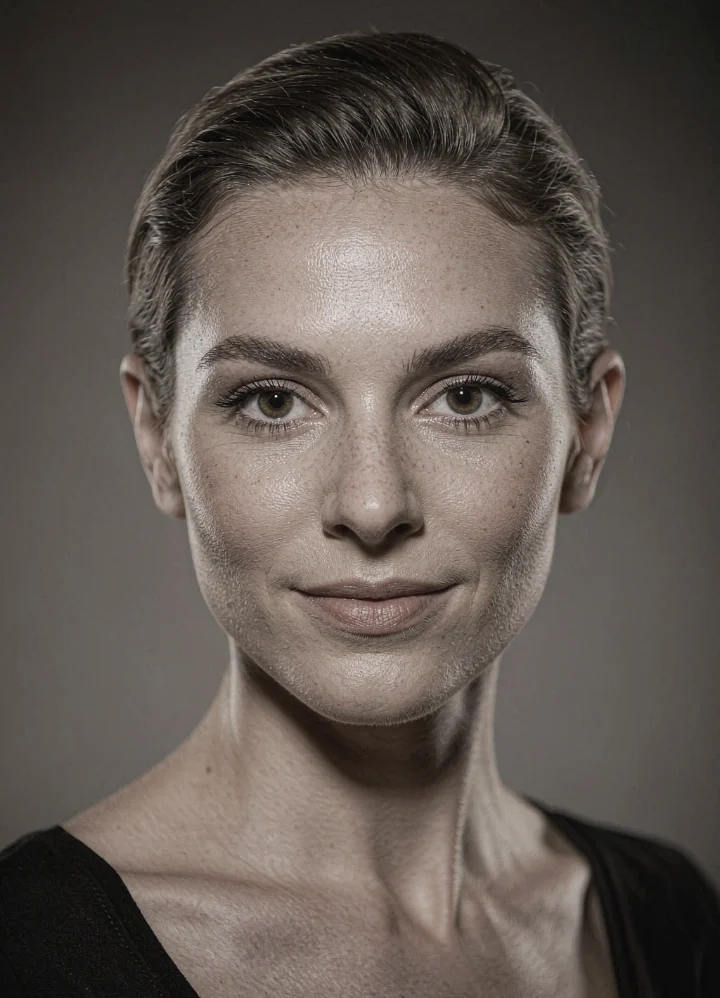
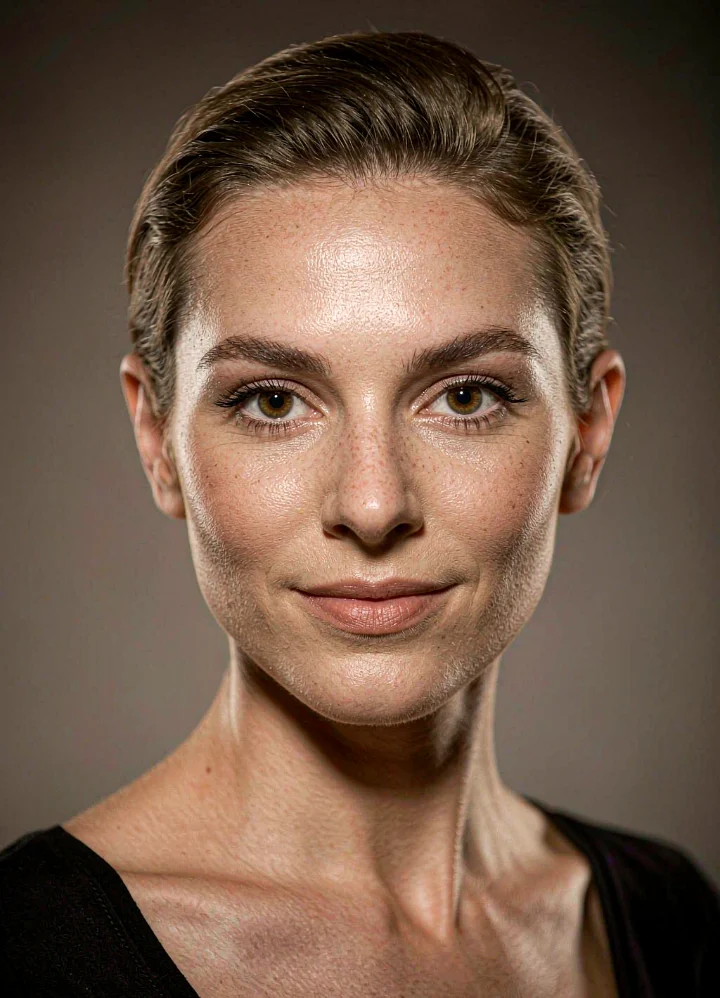
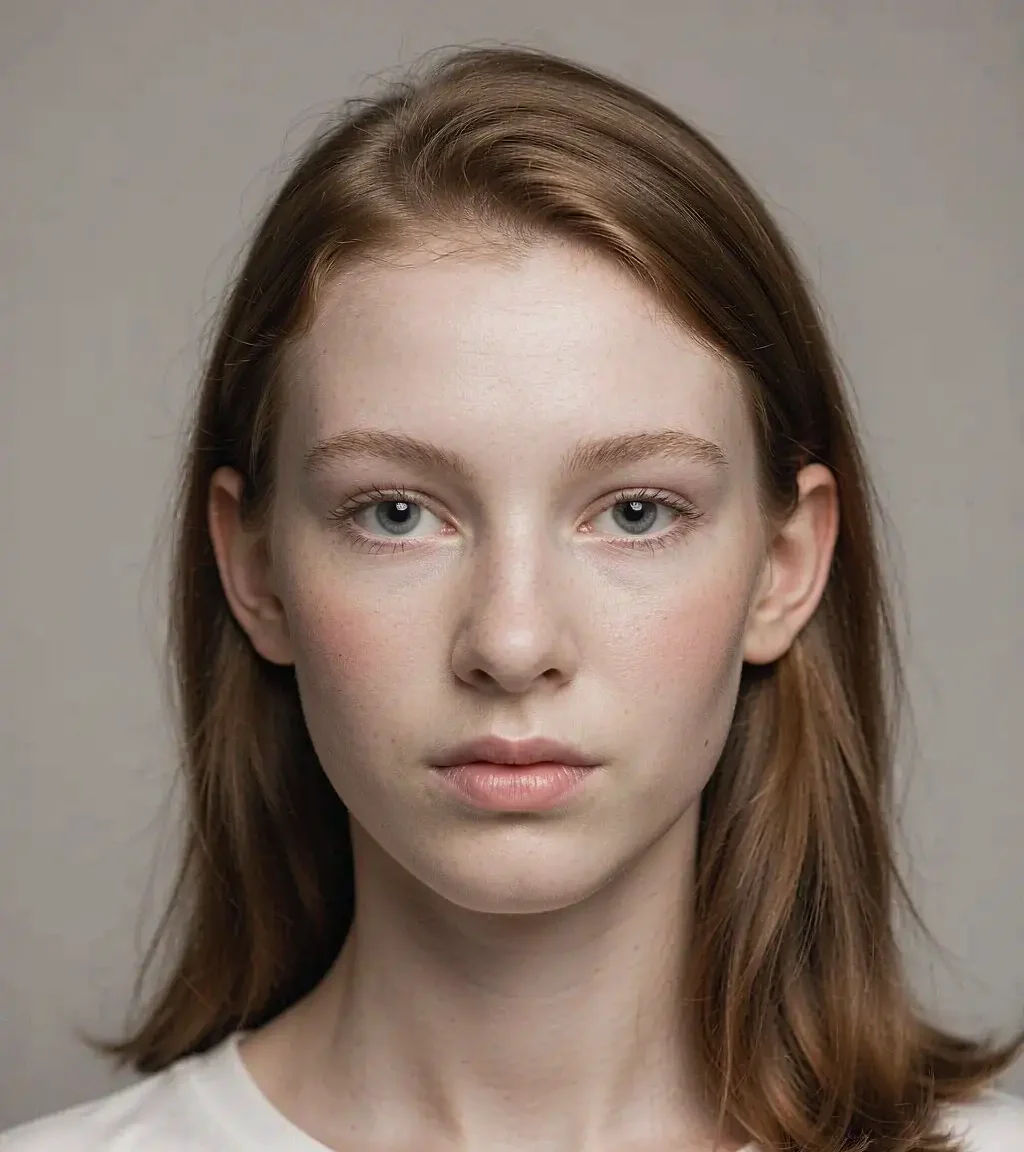
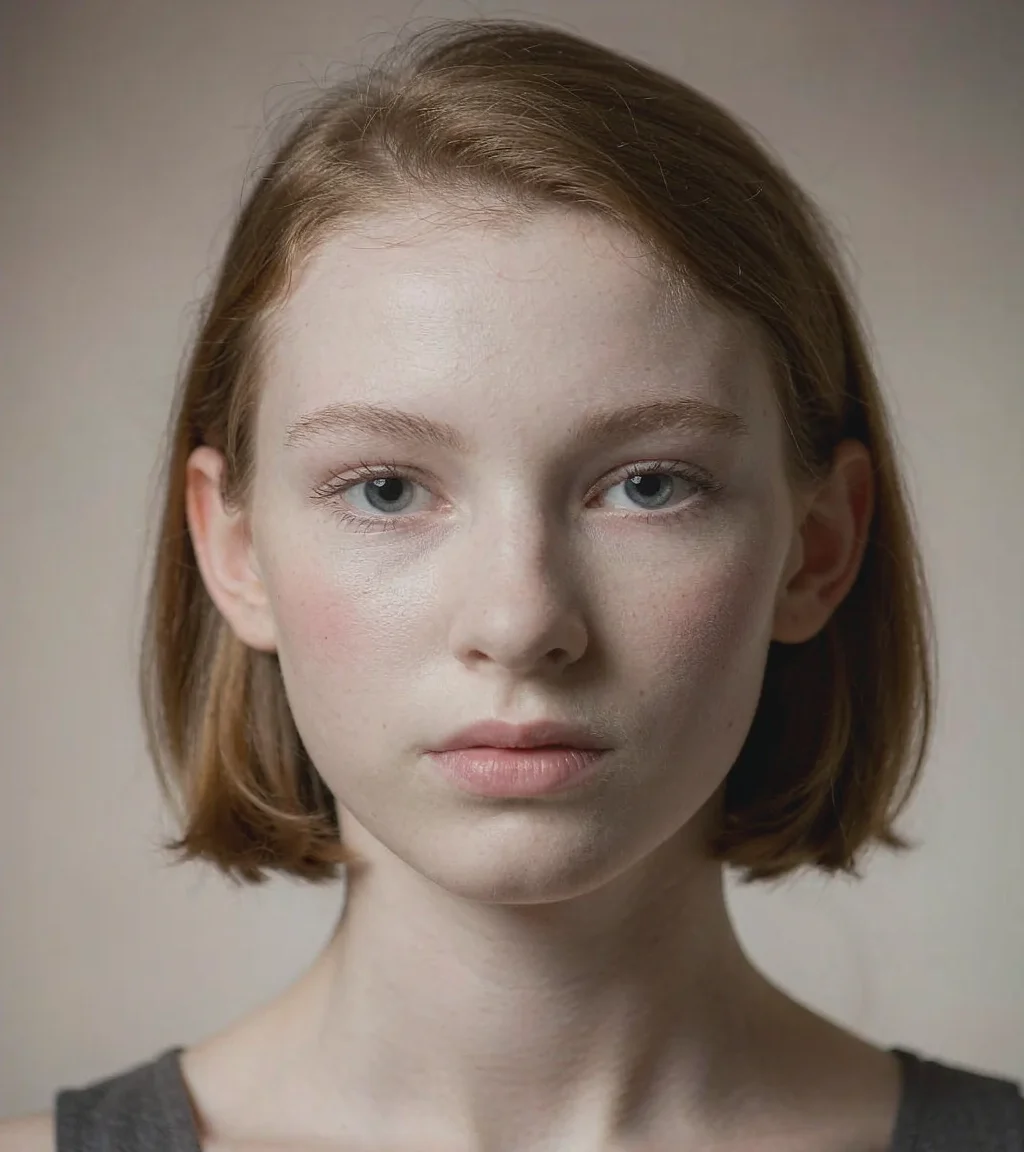
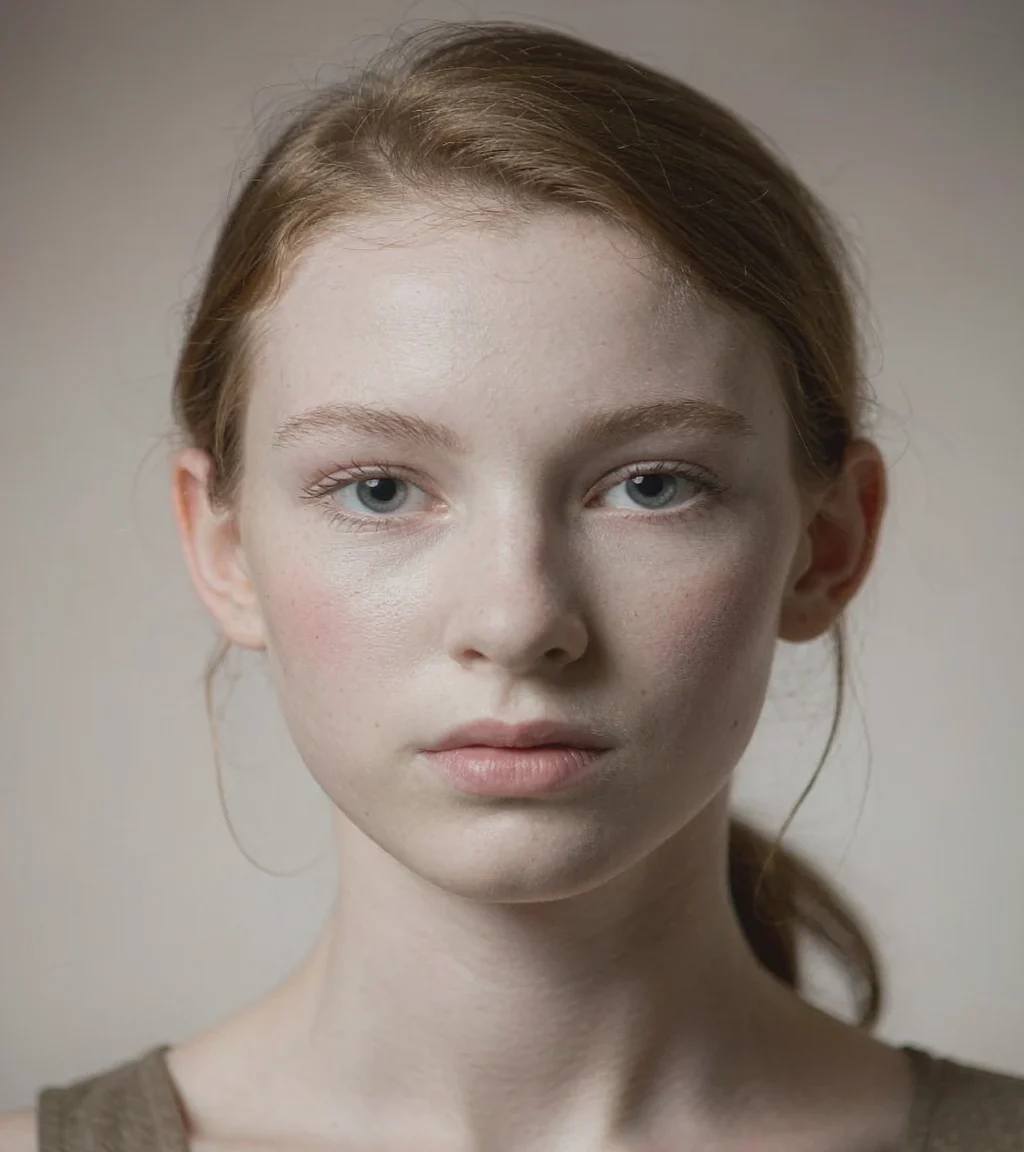
This is the exact report a buyer receives, rendered live from real pipeline output rather than a mock-up. Synthetic subject: an AI-generated portrait, not a real person. Everything drawn on it is measured from that image, and the report never recommends a procedure.
The useful answer first. The measurements and the evidence below are there when you want the detail.
Standout strengthSymmetryYour highest of the six measured geometry signals.
Highest-leverage areaBackground quietA property of the photograph — fully under your control.
First style to tryMiddle partMatched to a oval read from your ratios.
Color seasonLight SpringClosest alternative: Light Summer.
Perceived age band27-37, typical guess 32Wide, entertainment-only, from this photo.
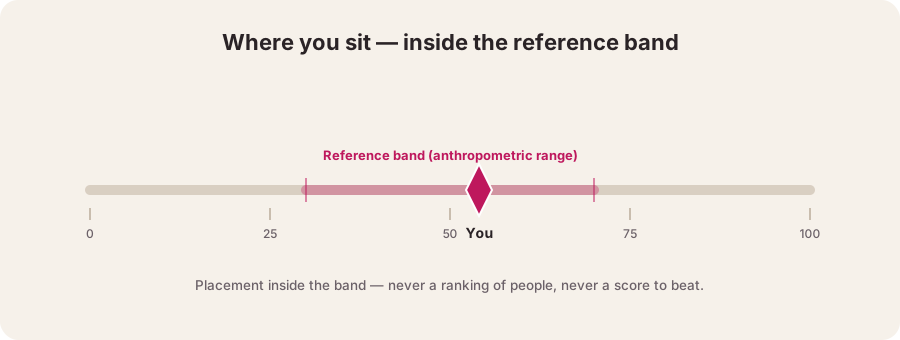
Where you sitUpper third of the reference bandYour overall harmony sits at the 69th percentile of the reference band, under this photo's conditions.
Do this firstTonightTonight and tomorrow morning, apply a cold compress or chilled spoon under the eyes and along the jawline for 60 seconds each side.
How to read this report. Scores are placement, not grades — 100 is not the goal, and strong faces sit all over a wide band. One photo is used honestly: where a front frame cannot support a read, this report says "not scored". Regions that need nothing get told nothing. Nothing here is medical.
Entertainment & self-insight only. Not medical, psychological, or dermatological advice. The Score is a weak geometric signal. It does not predict matches, dates, replies, or your worth. There is no leaderboard here. We don't rank you against other people. Your free result is never blurred, locked, or held back. This report never recommends procedures, never ranks you against an ethnicity-based ideal or another person's face, and never promises a score gain.
AI-generated · illustrative
Chapter 1 · the read, visualised
Your face, measured
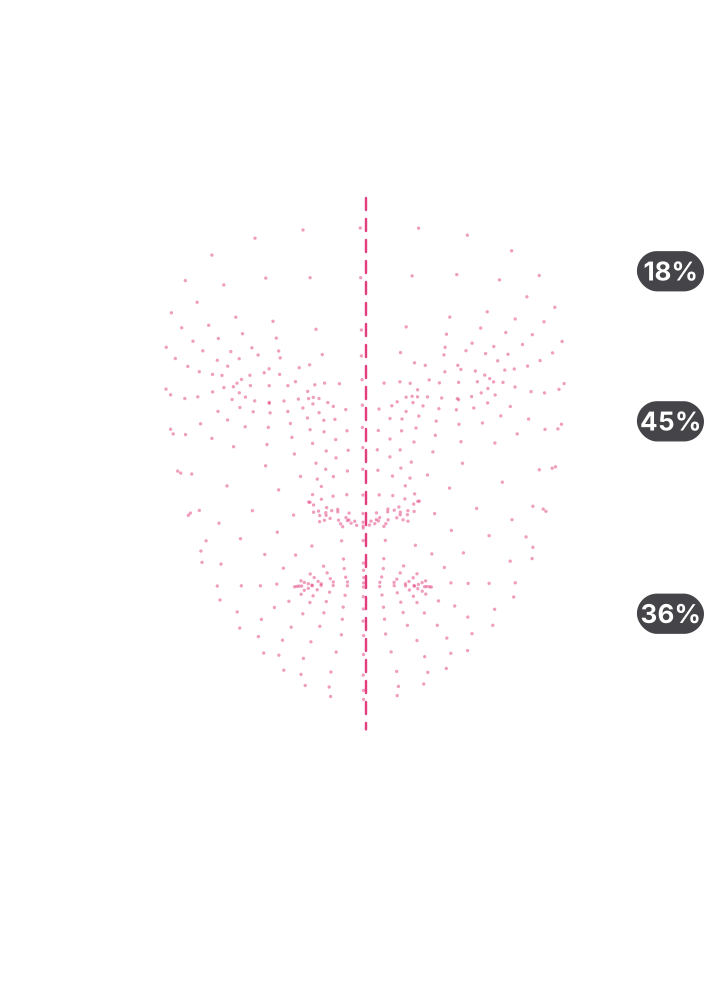
Your face mapped with six on-device geometry signals, with the proportions that drive the score drawn on top: brow balance, eye level, nasal midline and the mouth-ratio line. Everything here is a measurement of a photograph, not a verdict on you.
Vertical symmetry axis and five proportion lines, each labelled.
Read as bands, not points — the score ships with a ± range.
Drawn on your device; the photo is never uploaded.
Symmetry, shown honestly
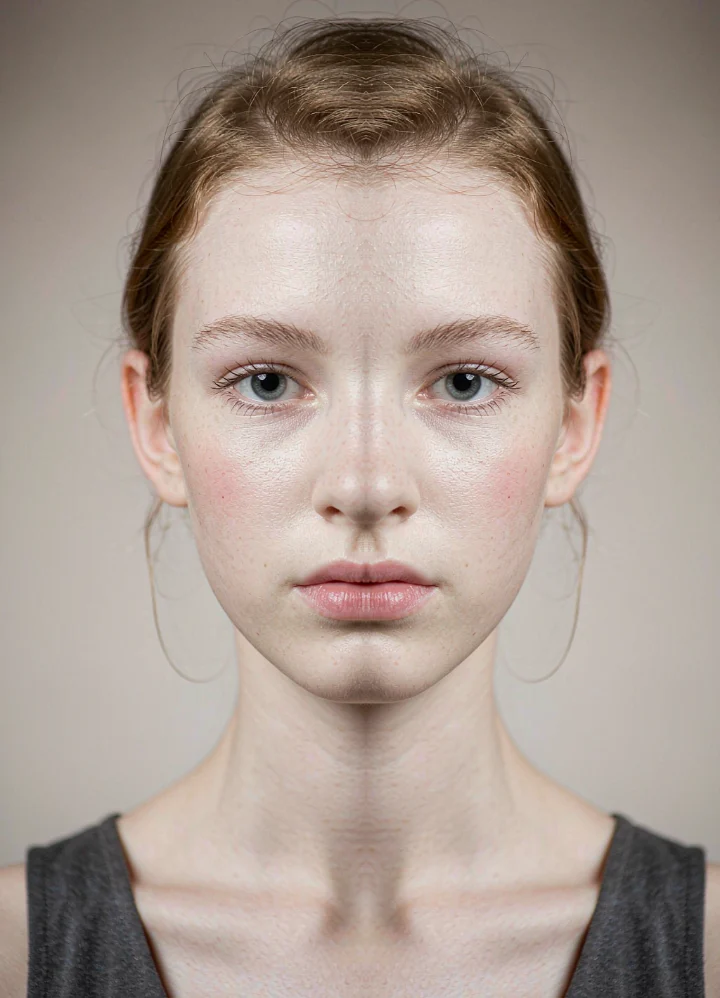
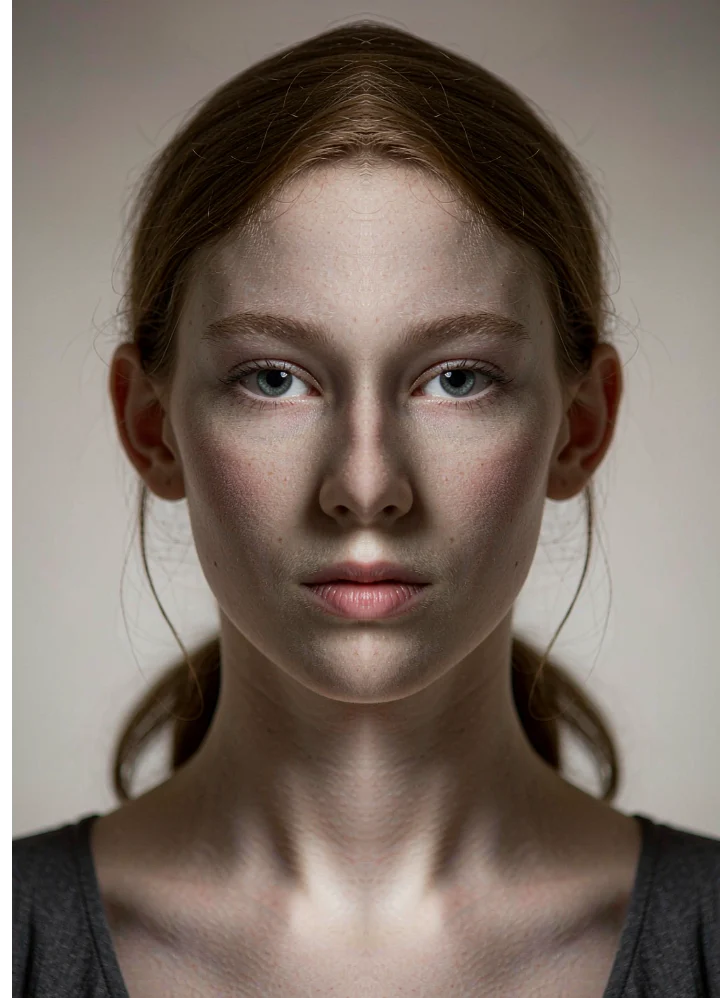
Your face, mirrored
Your face rebuilt from its left side and from its right, each half reflected across your own facial axis — the classic symmetry test, done on your landmarks rather than a vertical split. Overall symmetry 81/100 against a median of 75.
Left × left
Right × right
Nobody's halves match. The differences you notice here are the ones the symmetry scores below measure — and most of them are photo, expression and light.
Skin · on-device
Your skin map
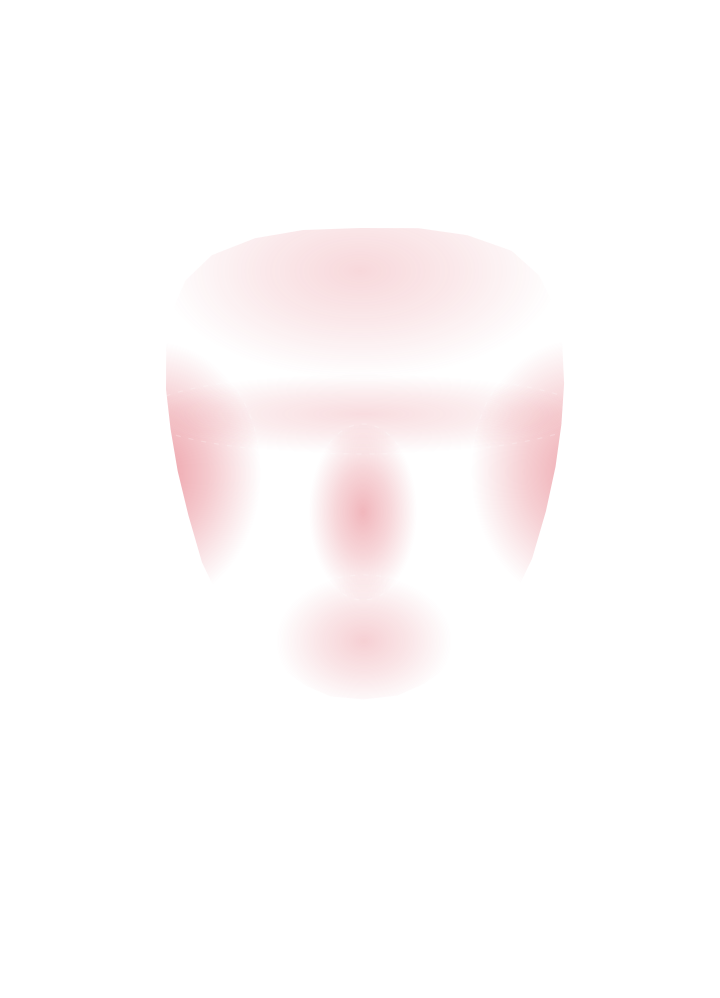
Four maps measured from your own pixels — redness, tone evenness, texture and shine — with the regions that drive the read shown as percentages.
Where your skin reads warmer than your own baseline tone.
Your overall tone evenness across the face.
Fine surface texture and pore visibility.
Where light reflects most — forehead, nose, cheeks.
RIGHT CHEEK53%
NOSE27%
CHIN9%
FOREHEAD7%
UNDER EYES3%
LEFT CHEEK2%
Sample illustration. A real scan measures these from your own pixels on your device.
Before / after
Your glow-up, held side by side
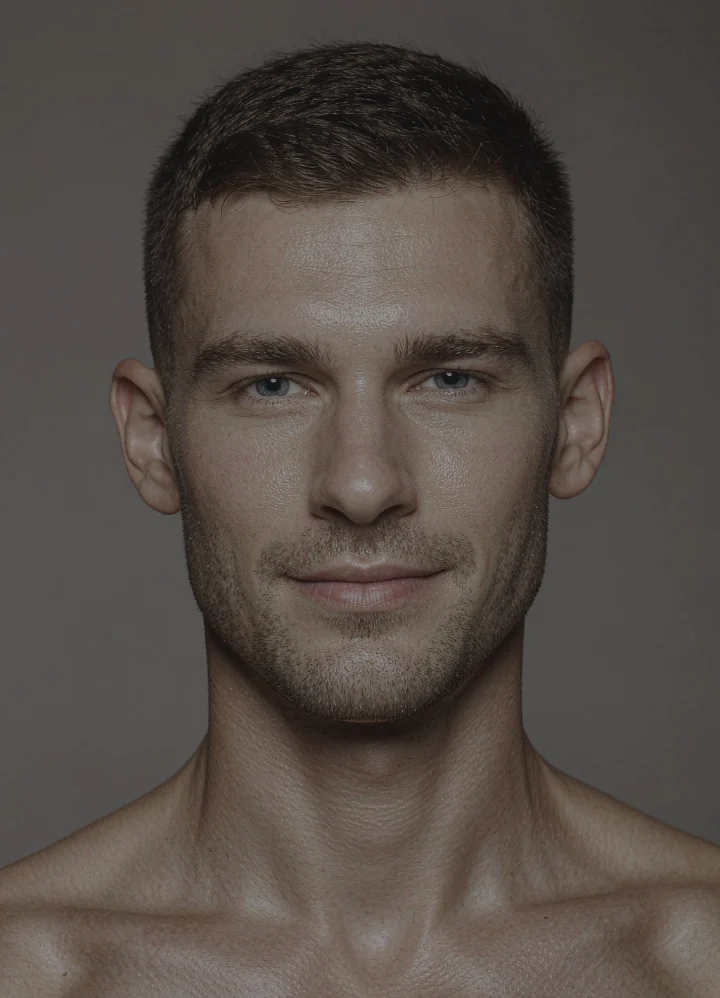
The same face, original and after the first 72 hours of presentation fixes. Press and hold the image to slide between them.
AI-generatedHold to compare
Illustrative only. The fixes are photography and grooming, not procedures — nothing about your face changes.
Three fixes, three faces
The three mistakes that cost you the most
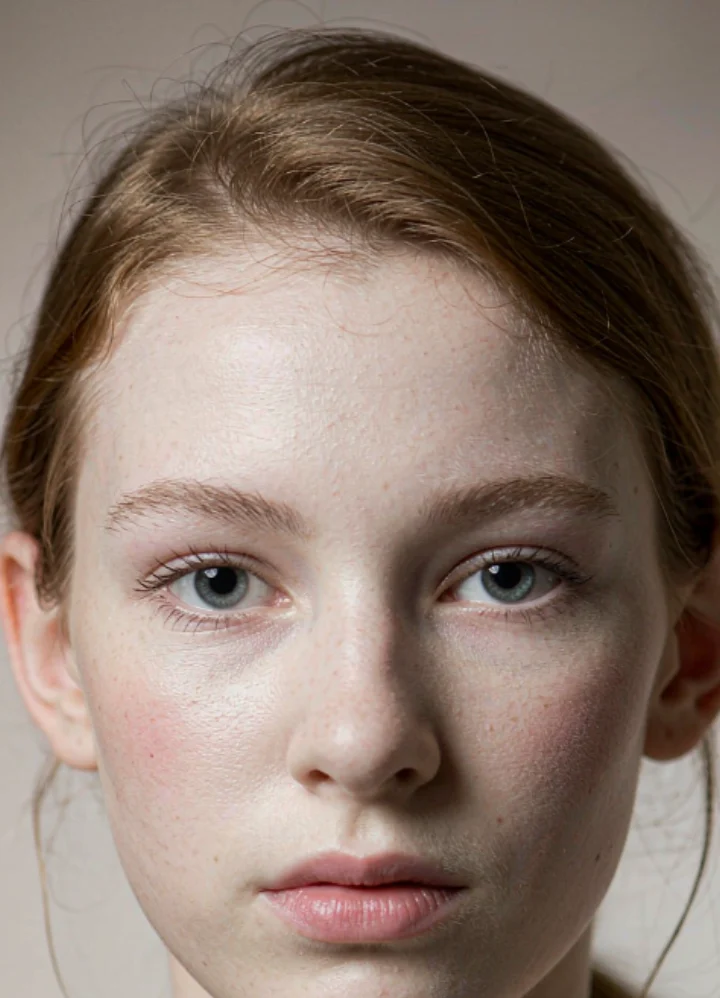
Not braces, not a jawline, not a filter — the crop, the light and the colour. Each pair below is the same photograph, presented worse and then presented properly. Nothing is retouched and no face is altered.
Before
After
FramingCropped too tight: the hairline and chin are clipped, so the thirds have no margins to sit in and the face reads as crowded.
Before
After
LightUnderexposed and flat: cheekbones, jawline and the eye sockets all collapse into one tone, so nothing structural reads.
Before
After
ColourDesaturated and cool: skin tone goes grey, the lips lose their edge and the whole frame looks like a scanned document.
Framing, light and colour are the three variables the photo-audit chapter ranks first, because they are free, reversible and move the read more than any edit to the face itself.
CH-02
Your starting read
The Score is a single, clearly-labelled estimate derived from six on-device geometry signals. It is not a grade, not a forecast, and not a measurement of you.
71 / 100
Estimated · pps-v2.0.0
above the reference range
Also shown as 7.1/10. Both come from the same published formula.
Confidence moderate · ±8Strongest signal SymmetryHighest-leverage area Background quiet (fully in your control)
Read the score as a band, not a point: 90% of photos like this land between 63 and 79.
Photo presentation 63/100 — Fine, one clear fixBiggest single fix Background quiet
Read this first. The Score is a weak geometric signal. It does not predict matches, dates, replies, or your worth.
The framing this report is built on
Your face is a weak, largely static signal; your dating profile is a set of editable decisions. We treat the face as roughly 30% of the picture and the controllable 70% — photos, styling, bio, platform choice and behaviour — as the work. That is not a promise that changing those things produces a particular number of matches. It is a statement about where your effort has leverage.
This chapter is your baseline. CH-27 to CH-33 are the editable 70%, ranked and scheduled.
Generated Nov 3, 2026 · Heuristic pps-v2.0.0 · Disclaimers dis-v1.0 · Order SAMPLE-0000. Estimated with a lightweight on-device geometry heuristic — not a 478-landmark clinical measurement.
Sample report — illustrative data, not a real scan.
Entertainment & self-insight only. Not medical, psychological, or dermatological advice. The Score is a weak geometric signal. It does not predict matches, dates, replies, or your worth. There is no leaderboard here. We don't rank you against other people. Your free result is never blurred, locked, or held back. This report never recommends procedures, never ranks you against an ethnicity-based ideal or another person's face, and never promises a score gain.
CH-03
What's working
Four findings, each with the number behind it. A short section is a clean bill, not a gap.
Symmetry at 81/100 — the strongest of your six geometry signals, sitting 80-100.
Golden Proportion at 74/100 — a second signal inside the broad reference range.
Canthal tilt - right eye measured at 7.60, inside its published reference band of -8–10.
Photo presentation 63/100 — fine, one clear fix; the seven properties and your three fixes are printed in full.
Your harmony profile
Each bar is a core dimension of facial harmony, scored 0–100. The dents are your highest-leverage areas. The median column is the published reference midpoint, not a measured cohort — we do not invent a sample size.
Symmetry
81reference midpoint 75
Golden Proportion
74reference midpoint 75
Facial Thirds
70reference midpoint 75
Facial Fifths
68reference midpoint 75
Eye Area
66reference midpoint 75
Jawline
58reference midpoint 75
Six dimensions, exact scores, and what each one means. The median is a descriptive anchor, never a target.
Illustrative · AI-generated The six regions behind the harmony profile, drawn over the photo.
Entertainment & self-insight only. Not medical, psychological, or dermatological advice. The Score is a weak geometric signal. It does not predict matches, dates, replies, or your worth. There is no leaderboard here. We don't rank you against other people. Your free result is never blurred, locked, or held back. This report never recommends procedures, never ranks you against an ethnicity-based ideal or another person's face, and never promises a score gain.
CH-04
Your first four weeks
Everything below is a photography or styling decision. Nothing here costs money, requires a purchase, or changes your face. The day-to-day plan comes before the evidence on purpose: the first week is about what to do, not how the number was calculated.
First 72 hours — start tonight
Tonight and tomorrow morning, apply a cold compress or chilled spoon under the eyes and along the jawline for 60 seconds each side. Temporary de-puffing only. It clears transient water retention for a few hours and changes nothing structural.
Do a 30-second posture reset every time you sit down: ears over shoulders, chin level, shoulders dropped. A forward head compresses the visible neck-jaw line in photos. This is a presentation fix, not a structural one.
Comb brows into place morning and night with a clean spoolie — no product needed. Stray hairs are the only thing competing visually with a measurement that is already yours.
Blot lips with a damp warm cloth for 10 seconds before balm, once daily. Removing flaky dry skin lets the lip border catch light evenly. A texture read, not a shape change.
Re-shoot one photo fixing background quiet only: Move two steps so the background is plain or softly out of focus. You should be the sharpest thing in the photo. One variable at a time is the only way to tell which change actually moved the numbers.
Your four-week program
WEEK 1Baseline and the first 72 hours
Save the current photo and its seven presentation properties. Tonight and tomorrow morning, apply a cold compress or chilled spoon under the eyes and along the jawline for 60 seconds each side.
Done when: One baseline photo + its numbers Cost: $0 · First signal: Immediately
WEEK 2Fix background quiet
Move two steps so the background is plain or softly out of focus. You should be the sharpest thing in the photo.
Done when: A re-shoot and a re-scan Cost: $0 · First signal: Immediately
WEEK 3Grooming and one style decision
Shape or simply comb the brows once, and try the first hairstyle from the decision cards in the same light.
Done when: One repeatable look, photographed Cost: $0-$25 · First signal: 1-2 days
WEEK 4Re-scan, like for like
Same lens, same window, same distance, same time of day. Compare the seven presentation properties and the framing, not the geometry estimate.
Done when: A written one-line comparison Cost: $0 · First signal: Compare on day 28
Week 4 is the point. Compare like for like. Nothing in this chapter is a promise of a score gain, and the geometry estimate is not expected to move at all.
Entertainment & self-insight only. Not medical, psychological, or dermatological advice. The Score is a weak geometric signal. It does not predict matches, dates, replies, or your worth. There is no leaderboard here. We don't rank you against other people. Your free result is never blurred, locked, or held back. This report never recommends procedures, never ranks you against an ethnicity-based ideal or another person's face, and never promises a score gain.
CH-05
Where you sit
Where you sit: Upper third of the reference band. Your overall harmony sits at the 69th percentile of the reference band, under this photo's conditions.
That is the plain answer to "what level am I?" — and it is a statement about where a number sits in a published band, not about where a person sits among other people. No ranking, no league table, and no claim that you are better than a percentage of other people.
Illustrative How placement works: your reading sits inside the published reference band (a range, not an ideal). A real anonymous distribution of scans measured on this site appears here once enough scans exist.
Reading
Yours
Reference band
Where that sits
Overall harmony
71 / 100
40 – 90
69th of the band
Symmetry
81 / 100
40 – 90
82th of the band
Golden Proportion
74 / 100
40 – 90
68th of the band
Facial Thirds
70 / 100
40 – 90
60th of the band
Facial Fifths
68 / 100
40 – 90
56th of the band
Eye Area
66 / 100
40 – 90
52th of the band
Jawline
58 / 100
40 – 90
36th of the band
Photo presentation
63 / 100
40 – 90
51th of the band
Forehead-top → chin ÷ cheekbone width
1.21
1.1 – 1.6
22th of the band
Upper band (forehead top → brow)
18.00%
14% – 30%
25th of the band
Middle band (brow → nose base)
45.00%
36% – 50%
64th of the band
Lower band (nose base → chin)
36.00%
28% – 42%
57th of the band
Inner-eye distance ÷ face width
25.00%
21% – 28%
57th of the band
Average eye width ÷ face width
21.00%
17% – 25%
50th of the band
Canthal tilt - right eye
7.6°
-8° – 10°
87th of the band
Canthal tilt - left eye
-10.0°
-8° – 10°
1th of the band
Brow-to-eye distance
16.1%
8% – 19%
74th of the band
Nose width ÷ face width
23.00%
19% – 27%
50th of the band
Mouth width ÷ face width
35.00%
30% – 46%
31th of the band
Mouth width ÷ nose width
1.55×
1.35× – 2.1×
27th of the band
Jaw width ÷ cheekbone width
75.00%
66% – 84%
50th of the band
Lower lip to chin ÷ face height
16.6%
11% – 20%
62th of the band
Measured-scan percentiles are omitted here: the anonymous distribution has fewer than the published minimum, and printing a percentile from a handful of scans would be an invented statistic wearing a decimal point.
How this is calculated
There are not yet 50 anonymous scans in the distribution, so this report shows placement inside the published reference band only — no invented cohort percentile, no made-up sample size. Once enough scans exist, a real, labelled distribution appears here automatically. The reference band is drawn from anthropometric literature and rounded outward; it is a range, not an ideal.
Band position is pure arithmetic: the value's place between the lower and upper bound of the published reference range. When enough anonymous scans exist, the same cell also prints the real distribution of scans measured on this site, with its sample size and self-selection bias stated. Buckets under five are hidden. The histogram holds only integer counters — no scanId, no email, no image, no per-person row. Deleting a photo after two hours never deletes a counter, and a counter can never be turned back into a photo.
In short — placement, not grades: each reading shows where your geometry sits in a measured range, and 100 is not the goal. Photo conditions can affect every comparison.
Entertainment & self-insight only. Not medical, psychological, or dermatological advice. The Score is a weak geometric signal. It does not predict matches, dates, replies, or your worth. There is no leaderboard here. We don't rank you against other people. Your free result is never blurred, locked, or held back. This report never recommends procedures, never ranks you against an ethnicity-based ideal or another person's face, and never promises a score gain.
CH-06
Every region, with its reference band
Every region read from your photo, with the band each measurement sits in and an explicit "not scored" state where a front frame cannot support the claim. Placement inside a shaded reference band — not a bare grade out of 100.
Overall proportions
Reading
Yours
Reference band
Placement
Forehead-top → chin ÷ cheekbone width
1.21
1.1 – 1.6
22th percentile · in the lower part of the reference band
Upper band (forehead top → brow)
18.00%
14% – 30%
25th percentile · in the middle of the reference band
Middle band (brow → nose base)
45.00%
36% – 50%
64th percentile · in the middle of the reference band
Lower band (nose base → chin)
36.00%
28% – 42%
57th percentile · in the middle of the reference band
Eye area
Reading
Yours
Reference band
Placement
Inner-eye distance ÷ face width
25.00%
21% – 28%
57th percentile · in the middle of the reference band
Average eye width ÷ face width
21.00%
17% – 25%
50th percentile · in the middle of the reference band
Canthal tilt - right eye
7.6°
-8° – 10°
87th percentile · in the upper part of the reference band
Canthal tilt - left eye
-10.0°
-8° – 10°
1th percentile · below the reference band
Brow-to-eye distance
16.1%
8% – 19%
74th percentile · in the middle of the reference band
Nose, mouth and jaw
Reading
Yours
Reference band
Placement
Nose width ÷ face width
23.00%
19% – 27%
50th percentile · in the middle of the reference band
Mouth width ÷ face width
35.00%
30% – 46%
31th percentile · in the middle of the reference band
Mouth width ÷ nose width
1.55×
1.35× – 2.1×
27th percentile · in the middle of the reference band
Jaw width ÷ cheekbone width
75.00%
66% – 84%
50th percentile · in the middle of the reference band
Lower lip to chin ÷ face height
16.6%
11% – 20%
62th percentile · in the middle of the reference band
Illustrative · AI-generated Your original photo with the measurement lines drawn over it. Every line is anchored on a landmark from your scan.
Explicitly not scored
Nose projection — Not scored, needs a side photo.
Bridge profile — Not scored, needs a side photo.
True gonial angle — Not scored, needs a side photo.
Chin projection — Not scored, needs a side photo.
Skin texture, pores and scarring — depends on light and resolution far more than on skin.
Reference bands are photo-calculator ranges drawn from anthropometric literature and rounded outward, not ideals. A value outside a band is a statement about the reference sample, never about a person.
Entertainment & self-insight only. Not medical, psychological, or dermatological advice. The Score is a weak geometric signal. It does not predict matches, dates, replies, or your worth. There is no leaderboard here. We don't rank you against other people. Your free result is never blurred, locked, or held back. This report never recommends procedures, never ranks you against an ethnicity-based ideal or another person's face, and never promises a score gain.
CH-07
Your Photo Presentation Score
The Photo Presentation Score (PPS) is the part of this report that is measured rather than estimated. Seven properties are computed from your pixels on your device: light evenness, sharpness, framing, background calm, contrast, headroom and colour cast. Nothing is uploaded. Full weights and thresholds are on the methodology page.
Your score is 63/100 — fine, one clear fix.
Light evenness
52
Sharpness
71
Framing & crop
78
Background quiet
44
Contrast & tone
66
Headroom & centring
74
Colour cast
61
Measured
Score
Band
What to do about it
Background quiet
44
40-59
Move two steps so the background is plain or softly out of focus. You should be the sharpest thing in the photo.
Light evenness
52
40-59
Face a window at eye level. Overhead light and one-sided sun are the two most common reasons a photo reads flat.
Colour cast
61
60-79
Mixed lighting (window plus tungsten) tints skin. Shoot in one light source or correct white balance afterwards.
Contrast & tone
66
60-79
Skip heavy filters. A little contrast is fine; crushed shadows lose the shape of your face.
Sharpness
71
60-79
Tap to focus on your eyes, hold still for half a second, wipe the lens. Most phone photos fail here, not on the face.
Headroom & centring
74
60-79
Put your eye line about a third down the frame and keep your face centred horizontally.
Framing & crop
78
60-79
Fine — leave it alone.
Your three fixes, in order
1. Background quiet (44/100). Move two steps so the background is plain or softly out of focus. You should be the sharpest thing in the photo.
2. Light evenness (52/100). Face a window at eye level. Overhead light and one-sided sun are the two most common reasons a photo reads flat.
3. Colour cast (61/100). Mixed lighting (window plus tungsten) tints skin. Shoot in one light source or correct white balance afterwards.
Because these numbers come from pixels, they move when you change the photo. Re-shoot, run the free scan again, and compare — that loop is the whole point. Nothing about your face is being re-scored here.
Important: a low PPS is not a statement about your face. It is a statement about one photograph — and a photograph is the most fixable thing in this entire report.
Entertainment & self-insight only. Not medical, psychological, or dermatological advice. The Score is a weak geometric signal. It does not predict matches, dates, replies, or your worth. There is no leaderboard here. We don't rank you against other people. Your free result is never blurred, locked, or held back. This report never recommends procedures, never ranks you against an ethnicity-based ideal or another person's face, and never promises a score gain.
CH-08
Your AI styling concept
Text alone should not be the difference between a free scan and a paid report. Your report includes 3 AI styling concepts rendered on your own photo — included in the price, with no credits spent.
SampleYour styling concept — One look: hair, grooming, light, clothing colour and believable facial refinement — a visualisation, not a prediction.
SampleA second direction — A conservative alternative cut, so the first card is a hypothesis and not a verdict.
SampleYour palette on you — The same photo with a wardrobe colour drawn from your measured palette.
This is a public sample, so the figures above are illustrative styling concepts generated on a sample portrait. In a delivered report this panel asks for your explicit consent before generating the concepts on your own photo — nothing is sent without it.
Styling, not a forecast. These concepts may refine hair, grooming, light, clothing colour and believable facial features for a best-day look — they are a visualisation for entertainment, not a prediction of structural change or a promise that a score will move. The original photo is never altered, and every generated image is labelled.
Included concepts do not use or reduce your AI credit balance. Extra looks and re-generations are available separately with prepaid credits. Generated concepts are stored with this report and can be deleted at any time from Delete my data.
Entertainment & self-insight only. Not medical, psychological, or dermatological advice. The Score is a weak geometric signal. It does not predict matches, dates, replies, or your worth. There is no leaderboard here. We don't rank you against other people. Your free result is never blurred, locked, or held back. This report never recommends procedures, never ranks you against an ethnicity-based ideal or another person's face, and never promises a score gain.
CH-09
Hairstyles on your photo
Six cuts matched to a oval read from your ratios. The top card is a hypothesis, not a verdict. Pick by the maintenance line, not the picture: the cut you will actually style beats the cut that photographs best.
Derived from your measured height-to-width (1.21), jaw-to-cheekbone (0.75) and middle-band share (45%). A photo-based shape estimate for styling, not a classification of your face.
Recommended for you
Middle part
Clean center part with hair falling to the sides
MaintenanceMedium
Styling time5 min
Cut cadence4-6 weeks
PartingCenter
VibeClassic, tidy
Trade-offA defined part needs daily combing; it reads unkempt faster than looser cuts.
Why it suits you: matched to a oval read. The honest tradeoff: A defined part needs daily combing; it reads unkempt faster than looser cuts.
Safe alternative
Soft waves
Loose waves with movement through the lengths
MaintenanceMedium
Styling time10 min
Cut cadence6-8 weeks
PartingCenter
VibeSoft, current
Trade-offNeeds a round brush or ten minutes with a hot tool to hold the bend.
Why it suits you: matched to a oval read. The honest tradeoff: Needs a round brush or ten minutes with a hot tool to hold the bend.
Safe alternative
Long bob
Collarbone-length clean lob
MaintenanceHigh
Styling time10-15 min
Cut cadence5-6 weeks
PartingCenter or deep side
VibeSharp, deliberate
Trade-offUnforgiving of skipped trims and humidity; the clean line is the look.
Why it suits you: matched to a oval read. The honest tradeoff: Unforgiving of skipped trims and humidity; the clean line is the look.
Safe alternative
Shag
Choppy layers with effortless volume
MaintenanceMedium
Styling time10 min
Cut cadence6-8 weeks
PartingCenter
VibeSoft, current
Trade-offAir-dried it relaxes to a flatter shape by afternoon.
Why it suits you: matched to a oval read. The honest tradeoff: Air-dried it relaxes to a flatter shape by afternoon.
Safe alternative
Blunt bangs
Straight fringe across the forehead
MaintenanceHigh
Styling time5-10 min
Cut cadence2-3 weeks
PartingFringe-led
VibeYouthful, deliberate
Trade-offFringe fights humidity and forehead oil; needs frequent trims.
Why it suits you: matched to a oval read. The honest tradeoff: Fringe fights humidity and forehead oil; needs frequent trims.
Bold pick
Asymmetrical bob
Edgy bob with offset lengths
MaintenanceHigh
Styling time10-15 min
Cut cadence5-6 weeks
PartingCenter
VibeSharp, deliberate
Trade-offThe asymmetry commits you to regular trims.
Why it suits you: matched to a oval read. The honest tradeoff: The asymmetry commits you to regular trims.
Every card carries the decision data a yes/no needs, including the honest tradeoff. Want different cuts? The Hairstyle Try-On generates six more on your own photo using prepaid credits.
Entertainment & self-insight only. Not medical, psychological, or dermatological advice. The Score is a weak geometric signal. It does not predict matches, dates, replies, or your worth. There is no leaderboard here. We don't rank you against other people. Your free result is never blurred, locked, or held back. This report never recommends procedures, never ranks you against an ethnicity-based ideal or another person's face, and never promises a score gain.
CH-10
Your 12-season palette
Color season: Light Spring
Season is shorthand for three measured attributes of your colouring — undertone (neutral), value (light) and contrast (medium) — and it decides which colours flatter by default. This is a photo-based estimate from one frame; Light Summer is the closest alternative, and the light in the room can move the verdict.
Attribute
Measured read
Undertone
neutral
Value
light
Contrast
medium
Closest alternative
Light Summer
Wear these near your face
Salmon#E89179
Soft terracotta#C77E5C
Warm coral#E08B6C
Buttermilk#EFDFAF
Light olive#98925E
Peach#F2B49A
Golden yellow#E4B95B
Fresh green#8FA86A
Warm ivory#F3E7CE
Apricot#EFA97C
These fight your coloring
Black#1A1A1A
Icy blue#C7DEED
Fuchsia#C7247E
Pure white#FFFFFF
Dusty mauve#9E8C9C
A photo-based estimate from undertone, value and contrast in one frame. It is not a draping session, not a diagnosis, and the light in the room can move the verdict.
Entertainment & self-insight only. Not medical, psychological, or dermatological advice. The Score is a weak geometric signal. It does not predict matches, dates, replies, or your worth. There is no leaderboard here. We don't rank you against other people. Your free result is never blurred, locked, or held back. This report never recommends procedures, never ranks you against an ethnicity-based ideal or another person's face, and never promises a score gain.
CH-11
The six geometry signals
Each number below is an estimate from a lightweight on-device image statistic — not a 478-landmark clinical measurement. The bars show placement inside a broad reference band, not a grade out of 100.
Symmetry Strong
81
Golden Proportion Moderate
74
Facial Thirds Moderate
70
Facial Fifths Moderate
68
Eye Area Moderate
66
Jawline Quiet
58
Signal
Estimate
Band
What the read means
Symmetry
81
80-100
Well inside the reference range. Mirror difference between the left and right halves of the detected face region. Lighting and head tilt move it more than your face does.
Golden Proportion
74
60-79
Inside the broad reference range. Where face height/width sits inside a broad reference band. Phi is a ratio note, not an aesthetic standard.
Facial Thirds
70
60-79
Inside the broad reference range. Balance of three vertical image bands. A front photo supports a rough read only.
Facial Fifths
68
60-79
Inside the broad reference range. Consistency of five horizontal bands across face width. Rough, and sensitive to crop.
Eye Area
66
60-79
Inside the broad reference range. Upper-band edge density and spacing proxy. Expression changes it substantially.
Jawline
58
40-59
Around the edge of the reference range. Lower-band width taper proxy. Gonial angle and chin projection are NOT scored from a front photo.
Illustrative · AI-generated The face every estimate in this chapter is computed from. On a real scan this is your own photo; the illustration is used for the public sample.
Not scored: nose projection, bridge profile, true gonial angle and chin depth. A single front-facing photo cannot support those claims, so we say "not scored" instead of guessing. A single front-facing photo cannot support side-profile claims. Where that is true, we say "not scored" instead of guessing.
Scores are placement inside a broad reference band, not grades. 100 is not the goal. This tool measures the photo, not your face directly. Lighting, angle, focal length and expression all move the reading. Aesthetic reference ranges in the literature carry documented bias. We treat them as rough bands, not ideals.
Entertainment & self-insight only. Not medical, psychological, or dermatological advice. The Score is a weak geometric signal. It does not predict matches, dates, replies, or your worth. There is no leaderboard here. We don't rank you against other people. Your free result is never blurred, locked, or held back. This report never recommends procedures, never ranks you against an ethnicity-based ideal or another person's face, and never promises a score gain.
CH-12
Symmetry and the midline
Symmetry carries the heaviest weight in the published formula (22%), which is exactly why it deserves its own chapter: the number is more fragile than it looks.
Your symmetry estimate is 81/100 — 80-100. It is computed by reflecting every landmark across your facial axis and measuring how far each point lands from its mirror twin.
Illustrative · AI-generated One half of a face reflected across the fitted axis. The doubled edges are the asymmetry the number is reading — and they are also what a two-degree head tilt produces.
Three things that move this number without moving your face
Head tilt. Two degrees of roll shifts the fitted axis and can move the estimate by five points or more.
Side lighting. A window on one side darkens one cheek; the landmark detector then places the shadowed contour slightly differently.
Expression. A half-smile pulls one mouth corner up and reads as asymmetry that is not there at rest.
What we will not tell you to do about it
Nothing. Measured asymmetry is bone and soft tissue, and the honest response to a low symmetry number is a straighter photo, not a procedure. This report never recommends surgery, fillers or injectables, and it does not rank ethnic features against a reference ideal. Aesthetic reference ranges in the literature carry documented bias. We treat them as rough bands, not ideals.
The useful version: shoot straight-on in even light, then compare. If the number jumps between two photos of the same face, the difference is the photograph, not you.
Entertainment & self-insight only. Not medical, psychological, or dermatological advice. The Score is a weak geometric signal. It does not predict matches, dates, replies, or your worth. There is no leaderboard here. We don't rank you against other people. Your free result is never blurred, locked, or held back. This report never recommends procedures, never ranks you against an ethnicity-based ideal or another person's face, and never promises a score gain.
CH-13
Facial thirds and fifths
Proportions are the most over-claimed measurement in this category, so here is the whole of what we do: three horizontal bands from hairline to brow to nose base to chin, and five vertical bands across the face measured in eye widths.
Your three bands
Measurement
Yours
Reference band
Placement
What it is
Upper band (forehead top → brow)
18%
14% – 30%
Inside the band
Measured from the top of the forehead, so it runs shorter than a hairline-based third.
Middle band (brow → nose base)
45%
36% – 50%
Inside the band
The most stable band across photos, because both ends are bone.
Lower band (nose base → chin)
36%
28% – 42%
Inside the band
Moves with jaw posture and with the camera height.
Illustrative · AI-generated The three bands and the fitted midline. The percentage labels are the measured share of total face height.
What the classic "rule of thirds" actually is
It is a drawing convention from portraiture, not a finding about human faces. Real populations vary widely, and the top band is dominated by where your hairline happens to sit rather than by bone. A face with a high hairline will read as a short upper third no matter what the bone underneath is doing.
What is genuinely worth knowing
The middle band is the stable one. Both ends are bone (brow and nose base), so it survives a change of camera better than the other two.
The upper band is a hairline measurement. Haircut and forehead coverage move it; nothing else does without intervention we do not recommend.
The lower band moves with the lens. Camera below eye level lengthens the chin; above eye level shortens it. This is perspective, not anatomy.
Fifths are reported as a consistency check rather than a target: five bands of roughly one eye width each. Frontal camera position matters more than any deviation from the convention.
Entertainment & self-insight only. Not medical, psychological, or dermatological advice. The Score is a weak geometric signal. It does not predict matches, dates, replies, or your worth. There is no leaderboard here. We don't rank you against other people. Your free result is never blurred, locked, or held back. This report never recommends procedures, never ranks you against an ethnicity-based ideal or another person's face, and never promises a score gain.
CH-14
The eyes and brows
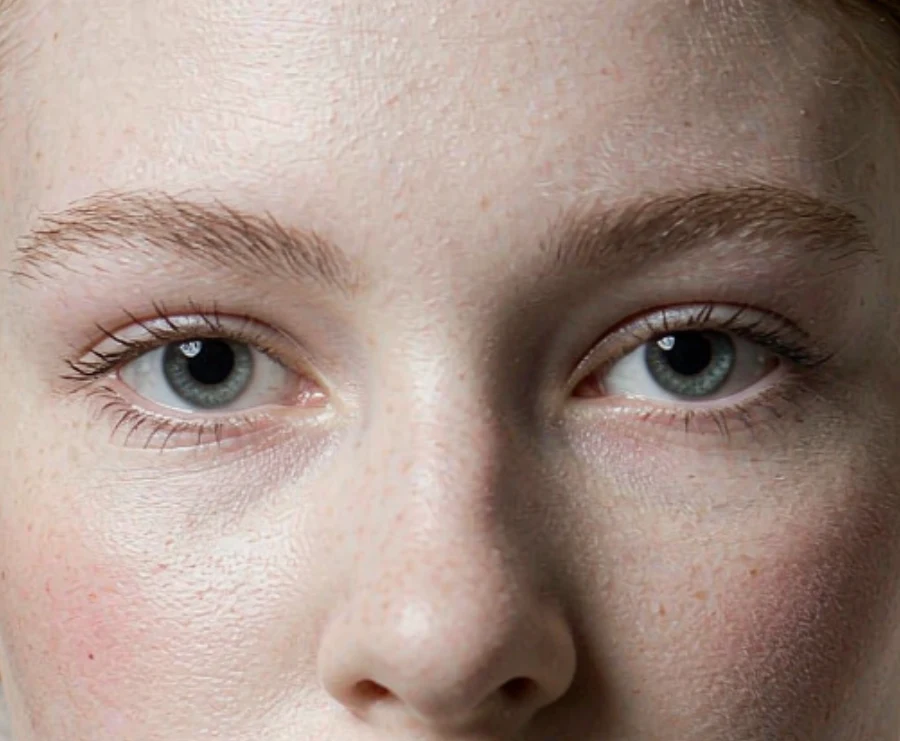
The eye area carries 14% of the Score and most of the questions. Four measurements are printed below, each between two named landmarks.
Measured, left and right separately
Measurement
Yours
Reference band
Placement
What it is
Inner-eye distance ÷ face width
25%
21% – 28%
Inside the band
The gap between the inner corners, as a share of face width.
Average eye width ÷ face width
21%
17% – 25%
Inside the band
Both eyes measured separately, then averaged.
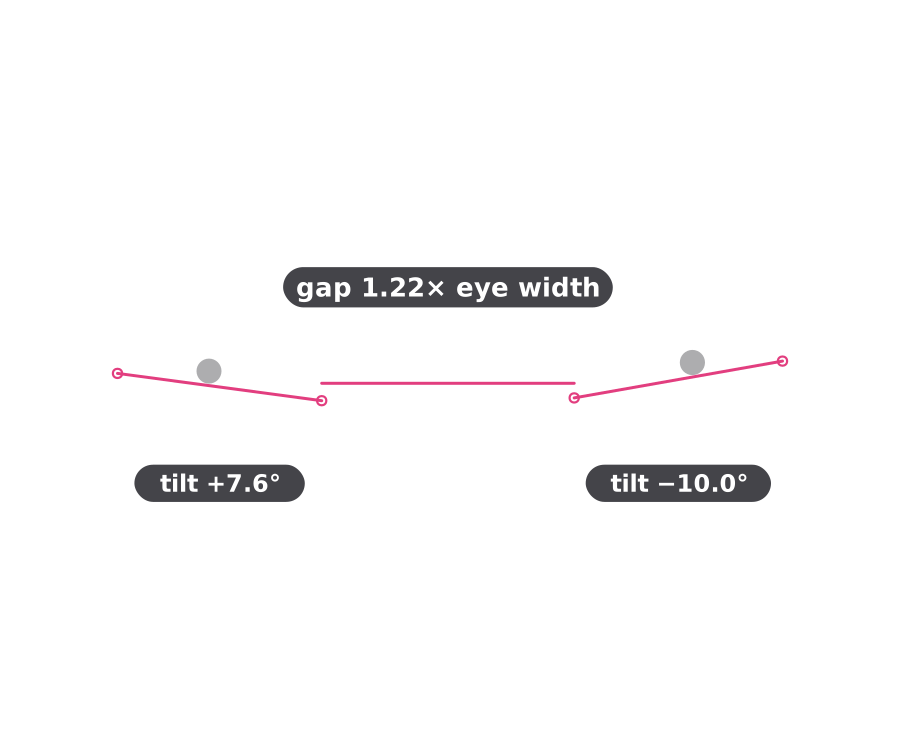
Canthal tilt - right eye
7.6°
-8° – 10°
Inside the band
Positive means the outer corner sits above the inner one.
Canthal tilt - left eye
-10.0°
-8° – 10°
Below the band
A left/right difference of a few degrees is ordinary.
Brow-to-eye distance
16.1%
8% – 19%
Inside the band
Measured from the lower brow edge to the eye corners, as a share of face height. Grooming moves this one.
Illustrative · AI-generated Eye width, the inner-corner gap and both canthal lines, drawn on the eye region of the photo.
Reading the canthal tilt honestly
Canthal tilt is the angle between the inner and outer corner of the eye. A positive value means the outer corner sits higher. The band is wide (-5° to +8°) because ordinary faces span it — and because the measurement moves with head roll and with the eyelid position in a single frame.
A left/right difference of a few degrees is normal and extremely common. It is not a defect, and this report does not treat it as one.
What is actually movable here
Brow shape and position — grooming changes the brow-to-eye distance and the perceived width of the upper face. It is the only high-leverage, reversible lever in this chapter.
Sleep and hydration — lid puffiness changes the measured aperture on the day. Nothing permanent, but it changes what the photo shows.
Camera height — shooting slightly above eye level narrows the aperture and flattens the tilt. This is a photography fact, not a face fact.
What we do not recommend: surgery, filler, injectables or anything else aimed at changing the shape of your eyes. The report is a measurement, not a referral.
Entertainment & self-insight only. Not medical, psychological, or dermatological advice. The Score is a weak geometric signal. It does not predict matches, dates, replies, or your worth. There is no leaderboard here. We don't rank you against other people. Your free result is never blurred, locked, or held back. This report never recommends procedures, never ranks you against an ethnicity-based ideal or another person's face, and never promises a score gain.
CH-15
Nose and midface
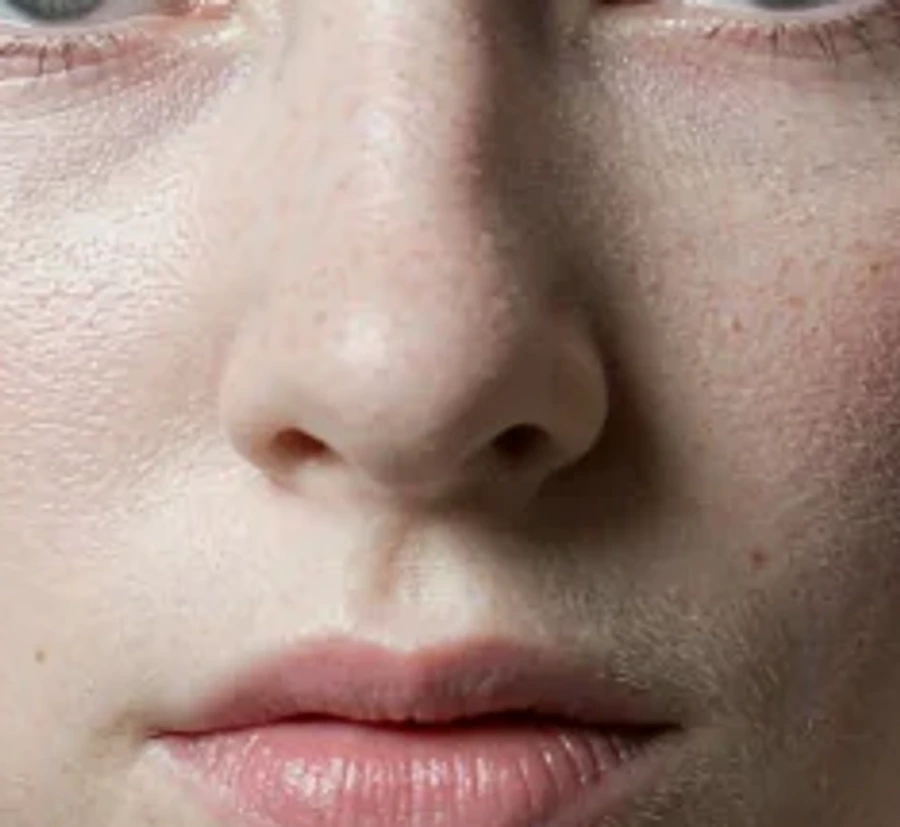
Front photo: width and symmetry only. A front frame supports width and symmetry readings only. Projection and bridge profile need a side view — this report does not score what it cannot see.
Nose and midface
Reading
Yours
Reference band
Placement
Middle band (brow → nose base)
45.00%
36% – 50%
64th percentile · in the middle of the reference band
Nose width ÷ face width
23.00%
19% – 27%
50th percentile · in the middle of the reference band
Mouth width ÷ nose width
1.55×
1.35× – 2.1×
27th percentile · in the middle of the reference band
Illustrative · AI-generated Nose width and the bridge axis, traced on your own photo. A front frame supports width and left/right balance only — projection and bridge profile need a side view, so they are not drawn.
Nose projection — Not scored, needs a side photo.
Bridge profile — Not scored, needs a side photo.
True gonial angle — Not scored, needs a side photo.
Chin projection — Not scored, needs a side photo.
Skin texture, pores and scarring — depends on light and resolution far more than on skin.
In short: the central face has one honest lever, and it is photographic — even light. Nothing here recommends a procedure.
Entertainment & self-insight only. Not medical, psychological, or dermatological advice. The Score is a weak geometric signal. It does not predict matches, dates, replies, or your worth. There is no leaderboard here. We don't rank you against other people. Your free result is never blurred, locked, or held back. This report never recommends procedures, never ranks you against an ethnicity-based ideal or another person's face, and never promises a score gain.
CH-16
Lips and smile
Lip balance is about the ratio between lip height and mouth width and how the mouth sits inside the lower face — not absolute size.
Lips and smile
Reading
Yours
Reference band
Placement
Lower band (nose base → chin)
36.00%
28% – 42%
57th percentile · in the middle of the reference band
Mouth width ÷ face width
35.00%
30% – 46%
31th percentile · in the middle of the reference band
Mouth width ÷ nose width
1.55×
1.35× – 2.1×
27th percentile · in the middle of the reference band
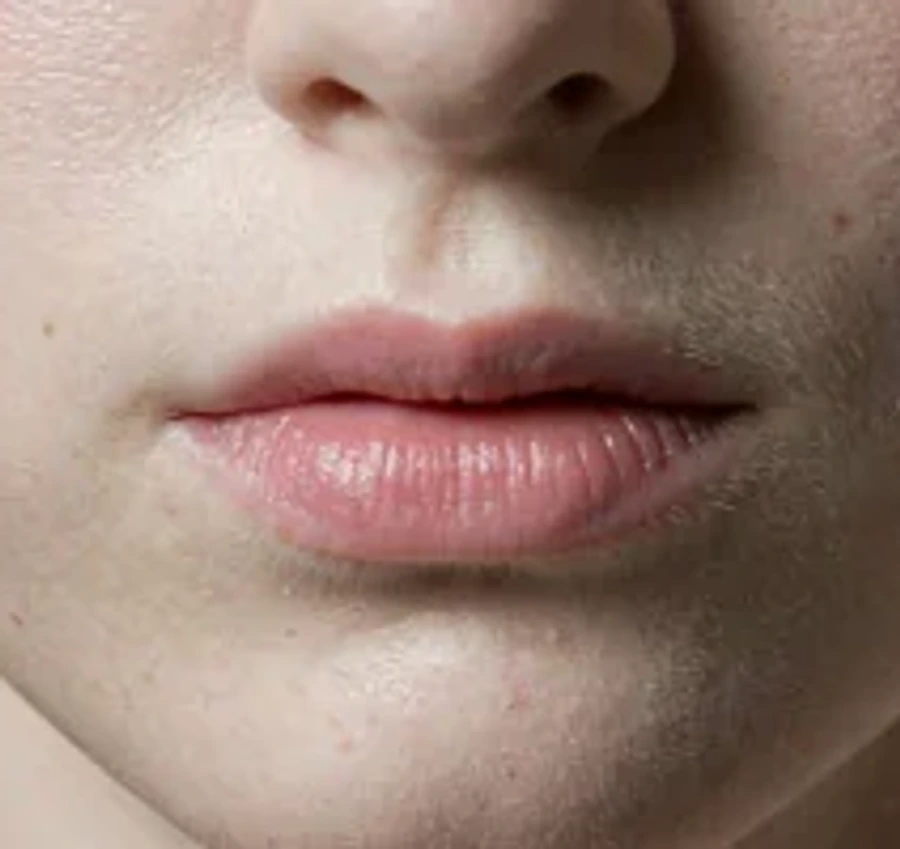
Illustrative · AI-generated Mouth width and lip height, traced on your own photo. Both are measured at rest, which is the value this report prints.
Mouth width is measured at rest. A smile widens it by several points, which is why the relaxed value is the one printed. Hydration and a tidy lip border change how the border catches light in a photo; nothing here changes shape or fullness.
Cosmetic suggestions for information and entertainment — not medical, dermatological or professional advice.
Entertainment & self-insight only. Not medical, psychological, or dermatological advice. The Score is a weak geometric signal. It does not predict matches, dates, replies, or your worth. There is no leaderboard here. We don't rank you against other people. Your free result is never blurred, locked, or held back. This report never recommends procedures, never ranks you against an ethnicity-based ideal or another person's face, and never promises a score gain.
CH-17
Jaw, chin and mouth
The lower third is where most of the internet's jaw advice makes its money, and where a front-facing photo is least able to support the claims being sold. Here is what we can measure and what we refuse to.
Measured lower-face proportions
Measurement
Yours
Reference band
Placement
What it is
Nose width ÷ face width
23%
19% – 27%
Inside the band
Alar width at the widest point. A front frame is the only honest view for this.
Mouth width ÷ face width
35%
30% – 46%
Inside the band
Corner to corner, relaxed. A smile widens it by several points.
Mouth width ÷ nose width
1.55×
1.35× – 2.1×
Inside the band
The classic "mouth is about 1.5x the nose" ratio, as a band.
Jaw width ÷ cheekbone width
75%
66% – 84%
Inside the band
Measured at the jaw corner. Body composition and camera height both move it.
Lower lip to chin ÷ face height
16.6%
11% – 20%
Inside the band
Lower lip to chin base, as a share of total face height.
Illustrative · AI-generated The jaw contour and mouth landmarks the lower-face ratios are computed from.
Three limits, stated plainly
Gonial angle needs a profile. The angle at the back of the jaw is invisible from the front. We report jaw width as a proxy and label it as one.
Chin projection needs a profile. Whether the chin sits forward of the lips cannot be read front-on. Not scored, anywhere in this report.
Jaw definition is partly body composition. Body fat affects how the jaw reads; that is a health-and-habit question, not a bone question, and this report does not prescribe either.
What genuinely moves the lower third in a photo
Camera height. A phone held at chest level foreshortens the chin and widens the jaw. At eye level, the proportions change without your face changing.
Jaw posture. A relaxed jaw with the tongue resting on the palate reads differently from a clenched one. It is free, reversible, and it is the only jaw advice in this report.
Beard line. If you wear one, the line sets where the jaw appears to end. That is a grooming decision with a visible effect and no risk.
Mouth width is measured at rest. A smile widens it by several points, which is why we print the relaxed value and say so.
Entertainment & self-insight only. Not medical, psychological, or dermatological advice. The Score is a weak geometric signal. It does not predict matches, dates, replies, or your worth. There is no leaderboard here. We don't rank you against other people. Your free result is never blurred, locked, or held back. This report never recommends procedures, never ranks you against an ethnicity-based ideal or another person's face, and never promises a score gain.
CH-18
Skin tone and photographic observations
Skin is the one part of this report where the honest answer is mostly "we measured a colour, not a condition". The tone read below comes from the average of the cheek and forehead regions, converted to an Individual Typology Angle (ITA) — a colour-space coordinate, not a health or beauty grade.
Reading
Value
What it means
Tone band
Light
One of six broad bands, derived from ITA. A description, not a ranking.
ITA
41°
A colour-space angle. Higher is lighter in the measured light — and the light is part of the measurement.
Undertone axis
neutral
Warm, neutral or cool, from the red/yellow balance. Useful for choosing colours, nothing more.
Reliability
Usable
The sample regions agreed with each other.
Illustrative · AI-generated The measured skin regions, drawn over the photo. The map shows where the sample was taken, not a severity.
What this is not
Not a dermatology read. No diagnosis, no severity score, no recommendation to treat anything.
Not a skin-age estimate. The wide perceived-age band on the first screen is an explicitly-labelled entertainment read from photographic cues in one frame — not your chronological age, not a dermatological estimate, and not a diagnosis.
Not a reason to lighten anything. This report never recommends skin lightening, bleaching or tone modification. Aesthetic reference ranges in the literature carry documented bias. We treat them as rough bands, not ideals.
What is reasonable, and boring
Broad-spectrum SPF every morning, sleep, water, and a cleanser that does not sting. That is the whole of the evidence-backed advice, and it is the same advice regardless of what the ITA number says. If a skin concern is bothering you, that is a conversation with a clinician, not with a face-measurement report.
Entertainment & self-insight only. Not medical, psychological, or dermatological advice. The Score is a weak geometric signal. It does not predict matches, dates, replies, or your worth. There is no leaderboard here. We don't rank you against other people. Your free result is never blurred, locked, or held back. This report never recommends procedures, never ranks you against an ethnicity-based ideal or another person's face, and never promises a score gain.
Observed in this photo, not clinical
Three photographic observations of this frame in this light — useful for tracking change, never a diagnosis. They are computed from the same pixel properties as your Photo Presentation Score, so a different light moves them without your skin changing.
Apparent smoothness
66How refined the skin texture looks in this frame. Sharpness and colour cast both move it.
Tone evenness
52How uniform the tone reads across the face in this light.
Under-eye area
59How rested the under-eye area looks — mostly a shadow-and-light read.
Perceived-age band, at a glance: 27-37, typical guess 32. A wide, entertainment-only band from photographic cues in this one frame — light, texture and shadow. It is not your chronological age, not a skin-age diagnosis, not a health read, and not a prediction. Re-shoot in different light and it moves. This is a wide entertainment read from photographic cues, not a skin-age estimate, not a diagnosis, and not your chronological age.
CH-19
Your ranked plan: face and styling
Ordered by visible payoff for the effort. Each move names the measurement it targets, its upkeep, and how confident the analysis is — none promises a score.
MOVE 1
Re-shoot the photo that carries the read
Targets Background quiet
Your background quiet reads 44/100 — the lowest of the seven measured photo properties. It is a property of this photograph, not of your face.
Face a window at eye level, with one plain low-contrast background.
Tap to focus on the eyes, hold still, wipe the lens, and step back rather than using a wide-angle close-up.
Re-run the free scan and compare the seven properties one by one — not the composite.
TypeStyling
How oftenOnce, then for each new photo
First signalImmediately
EffortLow
Cost$0
ConfidenceHigh — measured from pixels
Why first: It is free, reversible, measurable in one afternoon, and it changes the only numbers in this report that are not estimates.
MOVE 2
Frame the upper face
Targets Brow-to-eye distance and the eye area
Your Jawline estimate is 58/100. A brow shape is the one reversible lever in this region; the bone underneath is not.
Comb brows into place with a clean spoolie morning and night.
If you shape them, keep the tails full length — the frame reads longer.
Nothing needs buying for this step.
TypeGrooming
How oftenDaily, two minutes
First signal1-2 days
EffortLow
Cost$0-$25
ConfidenceModerate
Why first: The fastest visible change after the re-shoot, and it does not touch anything fixed.
MOVE 3
Work with your canthal tilt - left eye
Targets Canthal tilt - left eye
Measured at -10.00 against a published band of -8–10 — below the reference band. A band is a range, not a target; this move is about how the ratio reads in a photo, not changing it.
Keep the camera at eye level; a low camera lengthens the lower third and widens the jaw.
Use soft side-parted volume rather than a hard centre line if you want more horizontal width.
Compare two photos in matched light before deciding anything is a "problem".
TypePresentation
How oftenPer photo
First signalImmediately
EffortLow
Cost$0
ConfidenceModerate
Why first: It costs nothing, needs no product, and it is the last move that has any visible effect at all.
In short — everything else in the diagnostic half is evidence; these three moves are its output. The dating-domain action plan is a separate chapter in the Dating Report.
Entertainment & self-insight only. Not medical, psychological, or dermatological advice. The Score is a weak geometric signal. It does not predict matches, dates, replies, or your worth. There is no leaderboard here. We don't rank you against other people. Your free result is never blurred, locked, or held back. This report never recommends procedures, never ranks you against an ethnicity-based ideal or another person's face, and never promises a score gain.
CH-20
Day-to-day: routine, habits, frames
The day-to-day side of the report. General, boring, evidence-backed, and identical regardless of what any number in this report says.
Daily routine, in order
AM: a gentle cleanser that does not sting
AM: broad-spectrum SPF, every morning regardless of the ITA reading
PM: remove the day with a second cleanse
PM: a plain moisturiser that supports the skin barrier
Retest in matched light three to four weeks after any change — progress judged in matched photos is real, progress judged in the mirror is mood
Key ingredients
Vitamin C for tone evenness
Niacinamide for texture
Ceramides for the barrier
Training and habits
Gentle neck side-stretches to release tension
A relaxed jaw rather than a clenched one
A short walk outside — the least cosmetic item here, and the one with the best evidence
Consistent high-factor SPF
Regular sleep
Enough water
Phone at eye level instead of a sustained downward chin tuck
Grooming
Clear brow gel to keep the frame tidy
A plain lip balm with a satin finish
Flyaway hairs tidied around the hairline
Frames for your face shape
For a oval read: maintain the natural balance — almost any frame width works.
Guidance
Eyeglasses
Wayfarer, Square, Geometric, Aviator
Sunglasses
Wayfarer, Aviator, Round, Square
Avoid
Oversized frames that cover the face and upset the natural proportions.
The safest rule is a frame as wide as the broadest part of your face. Cosmetic suggestions for information and entertainment, not medical or professional advice. For any skin or health concern, see a qualified professional.
Entertainment & self-insight only. Not medical, psychological, or dermatological advice. The Score is a weak geometric signal. It does not predict matches, dates, replies, or your worth. There is no leaderboard here. We don't rank you against other people. Your free result is never blurred, locked, or held back. This report never recommends procedures, never ranks you against an ethnicity-based ideal or another person's face, and never promises a score gain.
CH-21
Your Face DNA
Your face measures inside reference bands on most of the structural ratios tracked. The strongest signal in this scan is symmetry at 81/100. That is a description of one photograph, not a verdict.
Distinctive features
A oval read with symmetry at 81/100 — the strongest signal in this scan.
Golden Proportion at 74/100, giving the region a consistent frame with no styling work required.
A measured 14 ratios inside published, deliberately wide reference bands — the "improvement areas" in this report are refinements, not corrections.
An explicit "not scored" list for nose projection, bridge profile, true gonial angle and chin depth, because one front photo cannot support them.
Reference silhouettes
Your proportions sit near the balanced-oval family in the reference atlas. We deliberately do not name real people: a celebrity face is not a reference population, and a lookalike list is not a measurement.
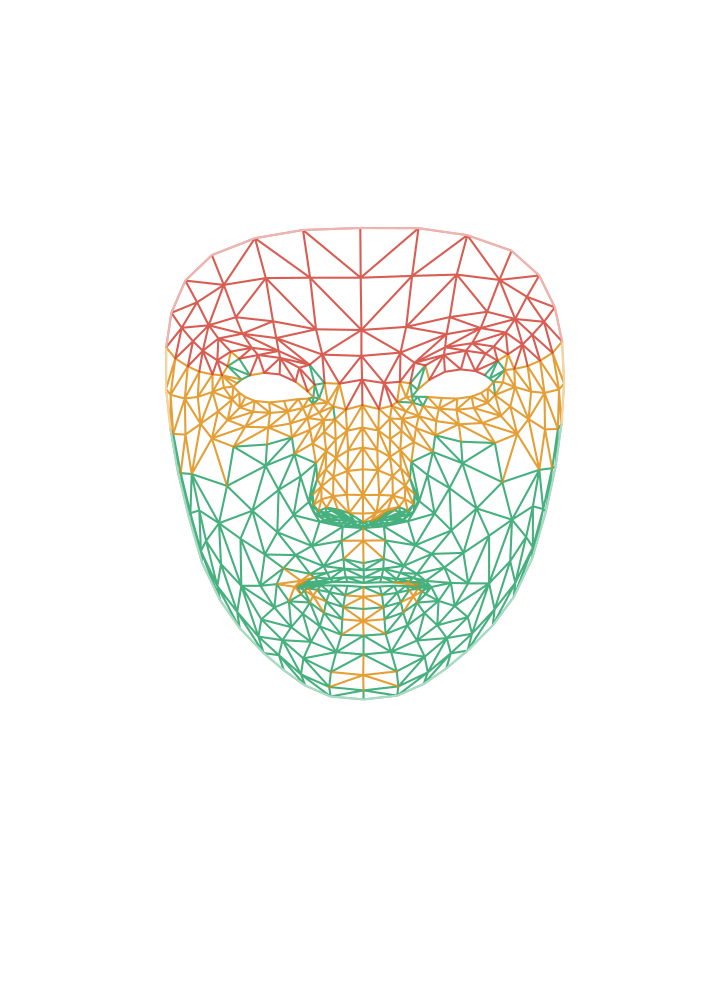
Illustrative · AI-generated Your distinctive features, traced on your own photo with the landmark mesh that produces the read.
Confidence notes
Regions that need nothing get told nothing — a short section is a clean bill, not a gap.
Scores here are placement, not grades: 100 is not the goal, and strong faces sit all over a wide band.
Nothing in this report predicts matches, dates, replies or your worth.
Reference silhouettes: your proportions sit near the balanced-oval family in the reference atlas. We deliberately do not name real people — a celebrity face is not a reference population.
Entertainment & self-insight only. Not medical, psychological, or dermatological advice. The Score is a weak geometric signal. It does not predict matches, dates, replies, or your worth. There is no leaderboard here. We don't rank you against other people. Your free result is never blurred, locked, or held back. This report never recommends procedures, never ranks you against an ethnicity-based ideal or another person's face, and never promises a score gain.
CH-22
Fixed vs. movable: what you can actually change
Most face-rating products stop at a number and leave you to work out what it implies. This chapter does the opposite: it sorts every input in this report into three buckets, so you can see exactly where effort pays and where it does not.
Input
Bucket
Why
What we recommend
Symmetry (D_sym)
Fixed
Set by bone and soft tissue. Measured symmetry also swings with head tilt and side lighting.
Nothing. Change the photo, not the face. A straight-on shot in even light is the honest read.
Golden proportion (D_gold)
Fixed
A ratio between fixed landmarks. Reference bands are population-specific and biased.
Nothing. We report the band and explicitly refuse to call it an ideal.
Facial thirds (D_thirds)
Fixed
Hairline, brow, nose base and chin position. Hairline styling shifts the top third slightly.
Haircut and forehead coverage only. No procedures.
Facial fifths (D_fifths)
Fixed
Vertical band consistency across face width.
Nothing. Framing and lens choice change how it reads in a photo.
Eye area (D_eyes)
Semi-movable
Lid opening and corner tilt are structural, but sleep, hydration, brow shape and swelling move the measured value.
Sleep, water, brow grooming. Never surgery, filler or injectables.
Jawline (D_jaw)
Semi-movable
Bone and body-fat both contribute; posture and sodium affect short-term appearance.
Body composition and posture if you want to, at your own pace. Nothing else.
Light evenness
Movable this week
Pure photography. Face a window; avoid overhead light.
Re-shoot. This is the single highest-return change available to you.
Soft directional light, one side slightly brighter.
Headroom
Movable this week
Too much empty space above the head makes the face smaller in the thumbnail.
Fill the frame with your face and shoulders.
Colour cast
Movable this week
Tungsten, shade and screens shift skin tone.
Shoot in daylight or set white balance once.
The honest summary: six of the seven measured photo properties are contestable within a week. Every one of the six geometry signals is either fixed or barely movable. That asymmetry is the point of this report — the number describes a photograph far more than it describes a future.
Where we draw the line. This report never recommends surgery, fillers, injectables, skin lightening, or any procedure. It also does not rank ethnic features against a reference ideal. Aesthetic reference ranges in the literature carry documented bias. We treat them as rough bands, not ideals. There is no leaderboard here. We don't rank you against other people.
Entertainment & self-insight only. Not medical, psychological, or dermatological advice. The Score is a weak geometric signal. It does not predict matches, dates, replies, or your worth. There is no leaderboard here. We don't rank you against other people. Your free result is never blurred, locked, or held back. This report never recommends procedures, never ranks you against an ethnicity-based ideal or another person's face, and never promises a score gain.
CH-23
How this report was measured
Every number in this report comes from one of three layers, and the layer is always stated. Mixing them silently is how face-rating products end up sounding more certain than the evidence allows.
Layer
What it is
How it was produced
How much to trust it
Measured
14 ratios and angles across four regions, plus seven photo-presentation properties
478 facial landmarks mapped in your browser, then plain arithmetic between named points
Deterministic for this photo. Re-shoot and the numbers move — that is the point of CH-27.
Estimated
The six geometry signals behind your Score
Published heuristic weights over landmark statistics
An estimate inside a wide band. It is not a clinical measurement and we never present it as one.
Self-reported
Goal, platform, photo type, time available, budget
Your answers in the short questionnaire
As good as your answer. Only used in the prescriptive chapters.
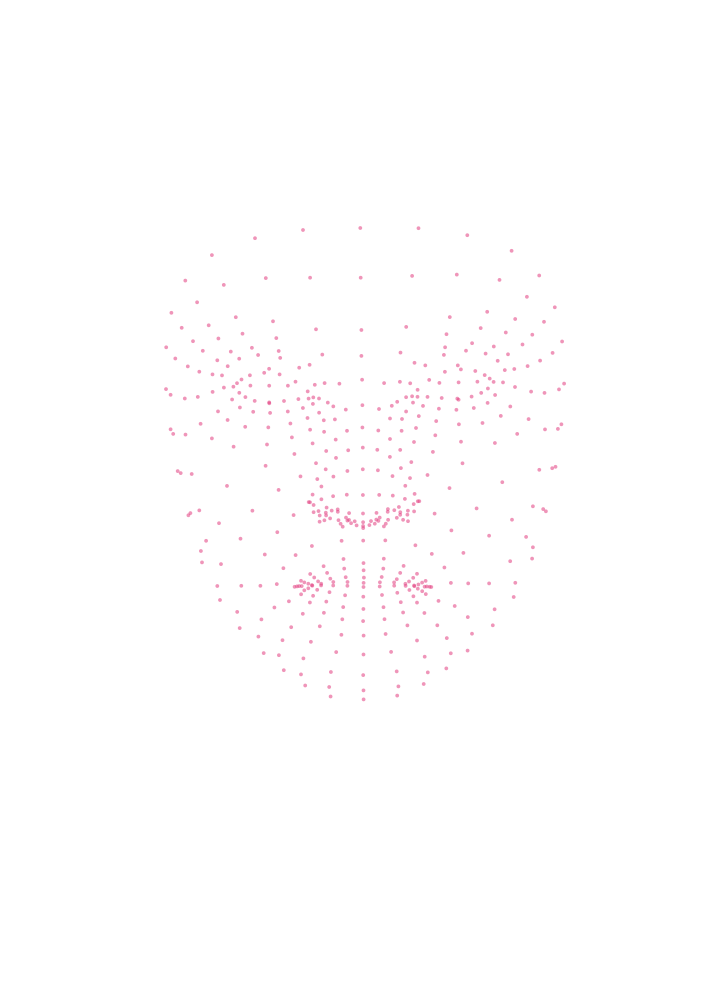
Illustrative · AI-generated The landmark layer every measurement in this report is computed from. On a real scan this is your own photo; the illustration is used for the public sample.
The measurement pipeline, in order
Decode locally. Your photo is drawn into a canvas in this browser. Re-drawing strips EXIF, including GPS. For the free scan your photo is processed on your device and is never uploaded, stored, sold, or used to train AI. The optional AI styling concepts included in a paid report are the only exception, and need a separate, explicit consent on the report page.
Map 478 landmarks. MediaPipe's face landmarker runs on the device (WASM, no network call) and returns x/y coordinates plus a coarse pose estimate.
Measure, then score. Distances and angles are computed between fixed landmark pairs; the six signals and the Score are computed from those with the published weights.
Store numbers only. The scan record holds values, never pixels. Only numeric scores are kept for 2 hours, then deleted.
What this pipeline cannot do. It cannot see profile depth, true gonial angle, chin projection, skin texture under different light, or anything about how you behave on a date. Where a claim would need a side photo or a second source, this report says "not scored" rather than inventing a number.
Engine pps-v2.0.0 · landmark model MediaPipe Face Landmarker · measurement code is deterministic, so the same photo and the same version produce the same numbers.
Entertainment & self-insight only. Not medical, psychological, or dermatological advice. The Score is a weak geometric signal. It does not predict matches, dates, replies, or your worth. There is no leaderboard here. We don't rank you against other people. Your free result is never blurred, locked, or held back. This report never recommends procedures, never ranks you against an ethnicity-based ideal or another person's face, and never promises a score gain.
CH-24
What this report can't tell you
This is the most important chapter in the report. Read it before you act on any number here.
It cannot predict matches, dates, replies, or your worth. The Score is a weak geometric signal. It does not predict matches, dates, replies, or your worth.
It does not measure you as a person. Warmth, humour, reliability, curiosity and kindness do not appear in any of the six signals.
It is not a scientific measurement. Estimated with a lightweight on-device geometry heuristic — not a 478-landmark clinical measurement. The weights are a disclosed heuristic calibration, not a universal formula.
One photo cannot show everything. A single front-facing photo cannot support side-profile claims. Where that is true, we say "not scored" instead of guessing.
The photo moves the number. This tool measures the photo, not your face directly. Lighting, angle, focal length and expression all move the reading. A different lens, light or expression would produce a different estimate.
Reference ranges carry bias. Aesthetic reference ranges in the literature carry documented bias. We treat them as rough bands, not ideals. We use them as rough bands, not ideals.
There is no leaderboard here. There is no leaderboard here. We don't rank you against other people. We never rank you against an ethnicity-based ideal or against another person's face. If a low score is making you feel bad, close the tab. This is a measurement, not feedback that should affect how you see yourself.
Background reading: Langlois & Roggman (1990); aggregated swipe-data analyses. Directional context, not a validation of this tool.
Entertainment & self-insight only. Not medical, psychological, or dermatological advice. The Score is a weak geometric signal. It does not predict matches, dates, replies, or your worth. There is no leaderboard here. We don't rank you against other people. Your free result is never blurred, locked, or held back. This report never recommends procedures, never ranks you against an ethnicity-based ideal or another person's face, and never promises a score gain.
CH-25
Boundaries: what this report will never do
This report is cosmetic and non-surgical guidance for information and entertainment. Here is what it will never do, in any section:
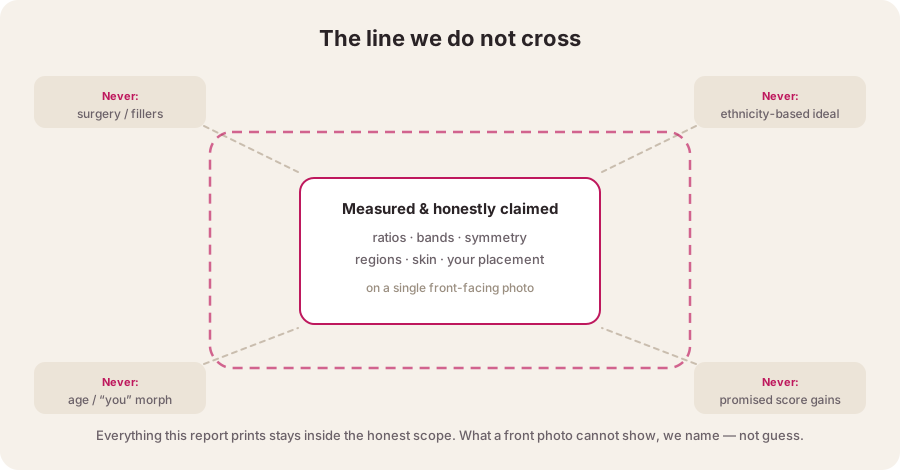
Illustrative The line we do not cross: everything this report measures and claims stays inside the honest scope of a single front-facing photo; surgery, ethnicity-based ideals, morphs and promised score gains stay outside.
Never Recommend surgery, fillers, injectables, skin lightening or any procedure — anywhere in this report.
Never Rank you against an ethnicity-based ideal, or against another person's face.
Never Show a "potential you" morph, or promise that a score will go up.
Never Diagnose a skin condition, estimate your chronological age, or predict dating outcomes.
One photo, honestly used. Anything that needs a side view, a second light source, a clinical instrument or a conversation is outside the scope of a single front-facing photograph. Where that is true, this report says "not scored" instead of guessing.
Cosmetic suggestions for information and entertainment — not medical, dermatological, psychological or professional advice. For any skin or health concern, see a qualified professional.
Entertainment & self-insight only. Not medical, psychological, or dermatological advice. The Score is a weak geometric signal. It does not predict matches, dates, replies, or your worth. There is no leaderboard here. We don't rank you against other people. Your free result is never blurred, locked, or held back. This report never recommends procedures, never ranks you against an ethnicity-based ideal or another person's face, and never promises a score gain.
Each D is a 0-100 estimate from an on-device image statistic (mirror difference, band luminance/edge distribution, region projection). Estimated with a lightweight on-device geometry heuristic — not a 478-landmark clinical measurement. The weights are our disclosed heuristic calibration, not a scientifically universal formula. Full method: How the Score is calculated.
Sources behind the framing (background, not validation of the score)
Background reading: Langlois & Roggman (1990); aggregated swipe-data analyses. Directional context, not a validation of this tool.
Langlois & Roggman (1990), Journal of Personality and Social Psychology — averaged faces and perceived attractiveness.
Rhodes (2006), Annual Review of Psychology — symmetry, averageness and their limits.
Little, Jones & DeBruine (2011/2014) — facial cues and individual variation.
Farkas (1994) — anthropometric facial norms; we cite it to explain why reference ranges are population-specific and biased, not as an ideal.
Lugaresi et al. (2019), MediaPipe — the landmark model behind the measured ratios in CH-06.
Publicly reported aggregated swipe data (e.g. SwipeStats) — we cite the general observation that photo quality affects swipe decisions, without inventing precise percentages.
Your rights
7-day refund: 7-day refund, no questions asked — just reply to your delivery email. We do not withdraw the report after a refund.
Your data: free scans leave no image behind; only numeric scores are stored briefly. Paid reports are private and kept up to 12 months unless you delete them.
Your photo stays in your own browser (IndexedDB) for the free scan. Delete it from the report header at any time; clearing site data does the same thing. The included AI styling concepts are optional and are generated only after a separate, explicit agreement: the source photo is held for that request only and never stored, while the generated concepts are kept with this report and are deletable at any time.
Anonymous percentiles use integer counters only — score buckets and dimension buckets. They hold no scanId, email, image or per-person row, and nothing below five scans is shown. Deleting your photo after two hours never deletes a counter, and a counter can never reconstruct a photo.
Entertainment & self-insight only · Not medical advice · Score is a weak geometric signal and does not predict matches · facerate.co
Entertainment & self-insight only. Not medical, psychological, or dermatological advice. The Score is a weak geometric signal. It does not predict matches, dates, replies, or your worth. There is no leaderboard here. We don't rank you against other people. Your free result is never blurred, locked, or held back. This report never recommends procedures, never ranks you against an ethnicity-based ideal or another person's face, and never promises a score gain.
CH-27
Photo leverage audit
Photos are the highest-leverage editable input, and they are the only part of this report measured directly from your pixels rather than estimated. This chapter is about the photograph, not your face.
Current photo type (self-reported): A group shot. Main friction: Matches but no replies.
Your photo, measured
Presentation score 63/100 — fine, one clear fix. Seven properties, measured on your device, with the published weights from the methodology page.
Light evenness
52
Sharpness
71
Framing & crop
78
Background quiet
44
Contrast & tone
66
Headroom & centring
74
Colour cast
61
Measured
Score
Band
What to do about it
Background quiet
44
40-59
Move two steps so the background is plain or softly out of focus. You should be the sharpest thing in the photo.
Light evenness
52
40-59
Face a window at eye level. Overhead light and one-sided sun are the two most common reasons a photo reads flat.
Colour cast
61
60-79
Mixed lighting (window plus tungsten) tints skin. Shoot in one light source or correct white balance afterwards.
Contrast & tone
66
60-79
Skip heavy filters. A little contrast is fine; crushed shadows lose the shape of your face.
Sharpness
71
60-79
Tap to focus on your eyes, hold still for half a second, wipe the lens. Most phone photos fail here, not on the face.
Headroom & centring
74
60-79
Put your eye line about a third down the frame and keep your face centred horizontally.
Framing & crop
78
60-79
Fine — leave it alone.
Your three fixes, in order
1. Background quiet (44/100). Move two steps so the background is plain or softly out of focus. You should be the sharpest thing in the photo.
2. Light evenness (52/100). Face a window at eye level. Overhead light and one-sided sun are the two most common reasons a photo reads flat.
3. Colour cast (61/100). Mixed lighting (window plus tungsten) tints skin. Shoot in one light source or correct white balance afterwards.
Because these numbers come from pixels, they move when you change the photo. Re-shoot, run the free scan again, and compare — that loop is the whole point. Nothing about your face is being re-scored here.
Your three-photo set
Photo 1 — the clear solo. Recent, whole face, soft front light, plain background, chest-up crop. No sunglasses, no heavy filter, no other people.
Photo 2 — the context shot. You doing something real, at a readable distance, still recognisably you.
Photo 3 — the texture shot. A different setting or angle that adds information rather than repeating photo 1.
The ten-minute checklist
Light: face a window; avoid overhead light and direct midday sun.
Background: tidy and low-contrast; you should be the sharpest thing in frame.
Angle: camera at eye level, lens at arm's length or longer to avoid perspective distortion.
Expression: relaxed and closed-mouth or a small genuine smile; take ten and pick the one that looks like you on a good ordinary day.
Recency: within the last six months. If someone would not recognise you from it, replace it.
Come back with a new photo any time — the free Dating Photo Analyzer reads lighting, background, angle and expression without rating your face.
Entertainment & self-insight only. Not medical, psychological, or dermatological advice. The Score is a weak geometric signal. It does not predict matches, dates, replies, or your worth. There is no leaderboard here. We don't rank you against other people. Your free result is never blurred, locked, or held back. This report never recommends procedures, never ranks you against an ethnicity-based ideal or another person's face, and never promises a score gain.
CH-28
Outfit & style anchor
One repeatable look beats a wardrobe of experiments when you only have three photos and limited time.
The baseline look
One well-fitting top in a solid colour that contrasts with your background and sits near your face.
One visual anchor — a jacket, a colour, a frame, a texture — that appears in at least two photos so the set feels coherent.
Grooming kept simple and consistent; nothing that needs a special occasion to make sense.
Budget bands
Budget
What to do
$0
Re-shoot in what you already own, using the light and background checklist in CH-27.
Under $40
One solid-colour top that fits well; nothing else is required.
$40+
Optional: a single anchor piece. Never buy something for one date.
We may earn a commission on partner links at no extra cost to you; see the Affiliate Disclosure. Comparisons are not paid. We do not recommend procedures, surgery, fillers or injectables anywhere in this report.
Entertainment & self-insight only. Not medical, psychological, or dermatological advice. The Score is a weak geometric signal. It does not predict matches, dates, replies, or your worth. There is no leaderboard here. We don't rank you against other people. Your free result is never blurred, locked, or held back. This report never recommends procedures, never ranks you against an ethnicity-based ideal or another person's face, and never promises a score gain.
CH-29
Bio & opening lines
Three complete, copyable bios and five openers. Use them as starting points — the best line always references something real in the other person's profile.
Bio 1
Two true things: I will always suggest the window table, and I will ask about the last thing you read. Looking for something steady and honest. Tell me the small thing you are enjoying this week.
Bio 2
Weekends: long walks and a terrible pun. Weekdays: learning to cook one dish properly. Here for good conversation and clarity, not a performance. Ask me about the dish.
Bio 3
Quietly competitive about bad puns, loudly loyal to my friends. I would rather ask a real question than play a game. What is a small thing that made you laugh lately?
Openers
Okay, that line about your weekend is a genuinely good answer. What got you into it?
I was going to play it cool, but your prompt deserves an actual question — how did that start?
Two options: we debate your take, or we skip the small talk and compare worst first dates. Your call.
That detail made me stop scrolling. What is the story behind it?
Small question first: is that still true this week, or has it escalated?
The coaching note: a contextual question beats a clever generic line. Ask about one detail, then make a concrete, low-pressure suggestion. If a conversation stalls, let it stall — volume is not the goal.
Entertainment & self-insight only. Not medical, psychological, or dermatological advice. The Score is a weak geometric signal. It does not predict matches, dates, replies, or your worth. There is no leaderboard here. We don't rank you against other people. Your free result is never blurred, locked, or held back. This report never recommends procedures, never ranks you against an ethnicity-based ideal or another person's face, and never promises a score gain.
CH-30
Market fit: where this profile works
Stated goal: Long-term relationship. Current main app: Hinge. Time available: 1-3 hours.
A face score is the same number everywhere. A profile is not: the same photos and bio have different friction in different dating markets. This chapter ranks four markets for your profile, using the rule published below — not a vibe, and not a prediction of matches.
Market
Fit
Why it scores here
First move
Relationship-first Hinge, Match, eHarmony
90
Longer profiles reward specifics, so your bio does the work your first photo cannot.
Rewrite the first prompt answer with two verifiable details, then set the new solo photo as #1.
Intentional, slower-paced Bumble, Hinge
74
One good conversation a week beats twenty dead ones; the profile only has to survive a slower read.
Open with one specific question from their profile, and cap yourself at five openers a day.
Off-app / in person Meetups, classes, friends-of-friends
70
Warmth, timing and nerve outweigh a photograph; the profile matters far less than the room.
Pick one recurring weekly room and go three times before judging it.
High-volume swiping Tinder, Bumble
68
Photo one carries almost the whole read here, and the decision happens in under two seconds.
Shoot three candidates in the same window light and lead with the sharpest, plainest one.
Fit = 0.34 goal alignment + 0.28 photo readiness + 0.20 effort fit + 0.18 tool fit. Fit is a positioning score, not a match forecast, and it does not change who you are.
Where you have least friction: Relationship-first (90/100) — Rewrite the first prompt answer with two verifiable details, then set the new solo photo as #1.
Where you have most: High-volume swiping (68/100). That is not a verdict on you; it is a statement about how much work that market asks for right now.
Affiliate disclosure: some links are partner links. We may earn a commission at no extra cost to you. Tinder, Bumble and Hinge don't run affiliate programs — our comparisons aren't paid. Tinder, Bumble and Hinge do not run affiliate programs, so our comparisons are not influenced by them. We only link partners we have actually joined — there are no placeholder partner links on this site.
Entertainment & self-insight only. Not medical, psychological, or dermatological advice. The Score is a weak geometric signal. It does not predict matches, dates, replies, or your worth. There is no leaderboard here. We don't rank you against other people. Your free result is never blurred, locked, or held back. This report never recommends procedures, never ranks you against an ethnicity-based ideal or another person's face, and never promises a score gain.
CH-31
The dating action plan
Everything else in this report is evidence; these three moves are the output. Each one targets an editable input, with cost, effort and an honest time-to-first-signal.
MOVE 1
Rebuild your first photo
Targets Photo leverage grade
Your first photo is the single highest-leverage input in aggregated swipe data, and it is fully in your control.
Take one new, recent solo shot in soft window light, whole face visible, plain background.
Crop to chest-up and make it photo #1.
Retire any group shot, heavy filter or sunglasses photo from the first position.
TypePhoto
How oftenPer new photo
First signalMore profile views — not guaranteed matches
EffortLow
Cost$0
ConfidenceWell-supported
Why first: Fastest visible change, zero cost, and it upgrades every other part of the profile.
MOVE 2
Replace adjectives with specifics
Targets Bio leverage grade
Generic bios give people nothing to reply to; two verifiable specifics do.
Write two concrete details (a place, a habit, a thing you are learning).
Add one low-stakes invitation: "Ask me about…".
Remove lists of demands and cliches.
TypeBio
How oftenOnce, refresh monthly
First signal2-3 weeks
EffortLow
Cost$0
ConfidenceWell-supported
Why first: The second-cheapest edit with a direct effect on reply quality.
MOVE 3
Concentrate on one app for four weeks
Targets Platform leverage grade
Spreading the same profile across many apps usually spreads your attention instead of your results.
Pick one app that matches your stated goal.
Set a fixed 15-minute daily window for it.
Review after four weeks before changing anything else.
TypePlatform
How oftenWeekly review
First signal4 weeks
EffortMedium
Cost$0
ConfidenceModerate
Why first: Consistency makes the other two moves measurable instead of guesswork.
In short — your highest-leverage area is Background quiet, which is entirely under your control. Scores are placement inside a broad reference band, not grades. 100 is not the goal.
Entertainment & self-insight only. Not medical, psychological, or dermatological advice. The Score is a weak geometric signal. It does not predict matches, dates, replies, or your worth. There is no leaderboard here. We don't rank you against other people. Your free result is never blurred, locked, or held back. This report never recommends procedures, never ranks you against an ethnicity-based ideal or another person's face, and never promises a score gain.
CH-32
Your 8-week Dating Standards Plan
A schedule, not a subscription. There is no auto-renewal, no streak penalty and nothing to cancel. Each week has one theme, one action and one thing you can point to as done.
WEEK 1Baseline
Screenshot your current profile. Write down what a stranger learns in five seconds.
Deliverable: A one-page baseline note Cost: $0 · First signal: Immediately
WEEK 2The first photo
Shoot and set the new solo photo in window light. Ask two friends which one reads most like you.
Deliverable: Photo #1 replaced Cost: $0 · First signal: More profile views
WEEK 3Supporting photos
Add two photos: one doing something, one with context. No group shots in the first three.
Deliverable: Three-photo set Cost: $0 · First signal: 2-3 weeks
WEEK 4Bio
Rewrite with two specifics and one invitation. Read it aloud; cut anything that sounds like a resume.
Deliverable: New bio Cost: $0 · First signal: Reply quality
WEEK 5Openers
Send five messages that each reference one real detail from the other profile.
Deliverable: Five contextual openers Cost: $0 · First signal: 2-3 weeks
WEEK 6Style anchor
Settle one repeatable date look: fit, solid colour, one visual anchor. Photograph it once.
Deliverable: A go-to outfit Cost: $0-$40 · First signal: Immediately
WEEK 7Platform focus
Review four weeks of activity. Keep the app that produced the best conversations, pause the rest.
Deliverable: One-app decision Cost: $0 · First signal: 4 weeks
WEEK 8Review, don't chase
Compare against your week-1 baseline. Keep what worked, drop one thing that did not, stop measuring your face.
Deliverable: A written review Cost: $0 · First signal: Ongoing
Week 8 is the point: compare against your week-1 baseline, keep what worked, drop one thing that did not, and stop measuring your face. The controllable 70% is where the leverage was all along.
Entertainment & self-insight only. Not medical, psychological, or dermatological advice. The Score is a weak geometric signal. It does not predict matches, dates, replies, or your worth. There is no leaderboard here. We don't rank you against other people. Your free result is never blurred, locked, or held back. This report never recommends procedures, never ranks you against an ethnicity-based ideal or another person's face, and never promises a score gain.
CH-33
Reality check & safety notes
This report does not rank you into a "tier" of people, and it does not promise a match rate. Dating outcomes depend on timing, location, other people's preferences and chance — none of which a photo score can model.
Calibration
Low activity for a few weeks is normal and is not evidence about your face.
A quiet week is a reason to review photos and openers, not to retake a face test.
Do not buy anything to chase a number. Nothing in CH-31 or CH-32 requires a purchase.
Red flags and breadcrumbing
Pressure to move off-platform immediately, requests for money, or inconsistent identity details.
Endless low-effort replies that never lead to a plan ("breadcrumbing") — it is fine to stop replying.
Anyone who makes you feel bad about your appearance is giving you information about themselves, not about you.
Meeting safely
First meeting: public place, your own transport, a friend who knows where you are.
Keep personal details private until trust is established; you owe nobody an explanation for leaving.
If a low score is making you feel bad, close the tab. This is a measurement, not feedback that should affect how you see yourself.
Entertainment & self-insight only. Not medical, psychological, or dermatological advice. The Score is a weak geometric signal. It does not predict matches, dates, replies, or your worth. There is no leaderboard here. We don't rank you against other people. Your free result is never blurred, locked, or held back. This report never recommends procedures, never ranks you against an ethnicity-based ideal or another person's face, and never promises a score gain.
Sample report — illustrative data, not a real scan.
The day-to-day side
Your glow-up plan
Your Face DNA, the first 72 hours, a four-week program, your routine and nutrition, and the reference guides.
What your numbers say about structure, and what they do not.
Your 81/100 overall symmetry and 91/100 eyebrow symmetry are already doing heavy lifting. The next 72 hours are about removing small static — puffiness, flyaways, posture slump — so your strong oval structure reads clearly on camera and in person. No bone structure changes, no score changes.
First 72 hoursStart tonight+
Five moves before anything else — momentum first.
Cold tool under the eyes and along the jaw for 60s each side. Temporary de-puffing only — helps the jaw angle read cleaner in early photos. Zero effect on structure or your jaw score.
30-second posture reset every time you sit: ears over shoulders, chin level (not down), shoulders dropped. A presentation fix, not a structural one.
Comb brows into place morning and night. Your brows already score 91/100 — grooming makes that asset fully visible.
Blot lips with a warm damp cloth 10s before balm. Removes flaky skin so the vermillion border catches light evenly.
Prop your phone at eye level for 3 nights. Stops the chin-down tilt that compresses the neck-jaw line in photos.
Face training plan4 weeks+
Week-by-week exercises for muscle tone, posture and tension release.
A four-week progression: posture and sleep in week 1, grooming system in week 2, lighting and framing drills in week 3, and a full re-shoot plus comparison in week 4. Each week has one theme and one deliverable.
Daily resetEvery day+
Your morning and night routine, step by step.
Morning: cold tool, posture reset, brow groom, lip care. Night: screen-height check, pillow posture, a two-minute skin reset. The point is consistency, not intensity.
Nutrition planOngoing+
What to eat, supplement, and cut for skin and structure.
Hydration, protein and sleep do more for skin and structure than any supplement. Cut excess sodium and alcohol before photo days. We never recommend pills as "face fixes."
Style vaultFor reference+
Camera angles, your colours and accessory picks.
Three camera angles that flatter your face shape, a small colour palette that sits near your face, and accessory anchors. Reference only — borrow what fits.
Price, what you provide, what you get, how it is delivered — in one table.
What you get
Price
$12.90 Face Report · $17.90 Dating Report. One payment, no subscription.
What you provide
One photo (optional) or a 2-minute questionnaire. Nothing else.
Face mapping
Six on-device geometry signals, published weights. No 478-landmark clinical claim.
Measurements
Photo Presentation Score (measured) + six estimated signals, each with a ± band.
Visuals
Face overlay, mirrored-face symmetry, skin-map and before/after diagrams (sample).
Plan
Ranked 3-move plan + 8-week schedule (Dating Report).
Delivery
Web report + emailed PDF. Saved 12 months, delete any time.
AI used
On-device image statistics only. No trained face model, no cloud.
Guidance
Photo, style, bios, market fit, safety. No procedures, ever.
Refund
7-day, no questions, report not withdrawn.
Your photo
Free scans never uploaded; only numbers kept ≤ 2 hours.
Run by
Face Rate — honest, entertainment-only face tools.
Frequently asked questions
Is this a real Face Rate report?
+
No. This is the exact chapter structure rendered from illustrative sample data, not a real scan.
How much does the report cost?
+
One payment of $12.90 for the Face Report or $17.90 for the Dating Report. No subscription, no auto-renewal, nothing to cancel.
Do I have to upload a photo?
+
No. Free scans process the photo on your device and never upload it; only numeric scores are kept briefly. The AI styling concepts included in a paid report are optional and need a separate, explicit consent on the report page — the source photo is held for that request only and never stored.
Can I get a refund?
+
Yes — 7-day refund, no questions asked. We never withdraw the report after a refund.
Is the Score scientific?
+
No. It is a weak, clearly-labelled geometric estimate from one photograph, not a clinical measurement or a prediction of matches.
Your turn
Same report, your face.
The free scan runs in your browser and takes a few seconds. The full report is one payment, no subscription.