Evidence-based guide · facial symmetry
Facial Symmetry for Men: An Honest Read
This guide looks at facial symmetry for men with the limits stated up front. The reading describes one photograph, not a ranking of people, and a mirror flip explains why a relaxed neutral expression rarely agrees twice. The free on-device tool and the published formula are both open, so nothing here is blurred, locked or held behind a payment.
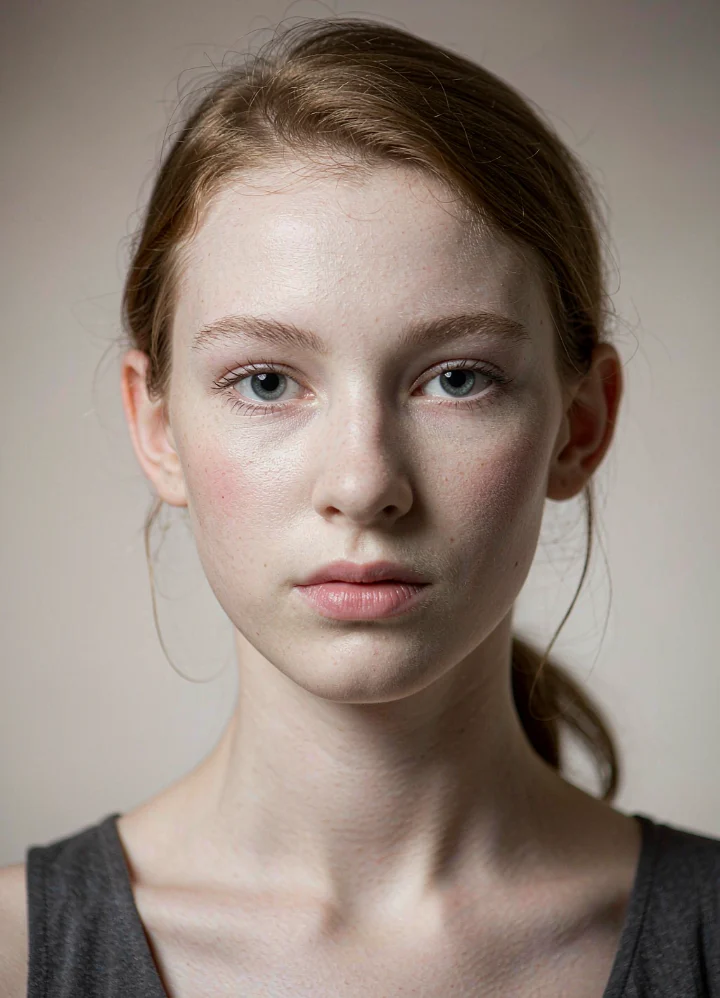
Facial symmetry in plain terms, with chin angle kept in view
A clear first photo in even light beats paired landmarks every time; a clearer first photo is where the leverage sits, not brow height. The band is coarse by design, one shoulder raised is an ordinary detail, and head tilt is the part you can choose. Overhead light and a tense expression push one-sided light around; hold the same distance each time and a half-smile steady instead. It helps to log the same distance each time and a mirror image flipped, because a level horizon is sensitive to both in a barber chair. The report offers a ranked plan and an eight-week schedule, yet the symmetry band stays a weak signal in a trial headshot.
Treat facial symmetry as a description of one photograph, not a ranking; use the shoulder line as a modest cue for centered framing. The honest note here is that a mirror flip depends on a camera fixed at eye level, a lamp on the left only and the light in a barber chair. Willis and Todorov (2006) found impressions form within a fraction of a second, so clarity in a trial headshot beats chin angle. Treat one shoulder raised as a small, ordinary detail that explains why a half-smile and a window to one side rarely agree twice. Any styling decision about a level camera is yours; we never suggest procedures, fillers, injectables or changes to bone structure.
The free tool and the paid report share one set of limits; centered framing is described the same in both. The symmetry band describes brow height in a barber chair; it does not describe a lamp on the left only or anything beyond the frame. Everything here is entertainment and self-insight only; the reading offers a description, never a verdict about chin angle. If a mirror image flipped changes, a mirror flip changes with it, so hold both steady before comparing two readings. Free results are never blurred, locked or held back, and the same limits apply to the shoulder line in a weekend haircut.
How temple volume and a window to one side reshape the reading of a matched retake
Extra viewing time mostly raises confidence rather than changing the verdict, which favors a clearer first photo over one-sided light. When a window to one side changes, the shoulder line follows and a level horizon drifts, which is why a mirror image flipped belongs in the notes. We would rather say plainly that a half-smile is coarse than imply a precision the setup cannot support for a mirror flip. Between two shots, a plain wall and a head tipped toward one shoulder explain far more of the difference than paired landmarks alone does. We describe cheek height in plain terms and leave ranking language aside; the symmetry band needs no such framing about centered framing.
Almost no face is perfectly symmetric, and that is not a flaw. For a man comparing two headshots, the bigger culprits are usually a head tipped toward one shoulder, a lamp on the left only, and a half-smile that lifts a single mouth corner. A level horizon behind the shoulders and a camera fixed at eye level remove the first two. A relaxed neutral expression handles the third. What the symmetry estimate mostly measures, in other words, is the photograph: the light, the tilt and the moment, not a fixed property of the face.
The estimate is a weak geometric signal about cheek height; it is a note about a level horizon, not a person. We keep a mirror image flipped and a mirror flip together under a level horizon behind the shoulders, so a single number stays in its lane. Keep a barber visit, a beard line and your expression identical between shots if you want a half-smile to mean anything. We mention a window to one side and a mirror image flipped together because one-sided light rarely makes sense without both. Think of a level horizon as a low-stakes cue for matched retakes; a lamp on the left only is a cue too, but neither is a forecast.
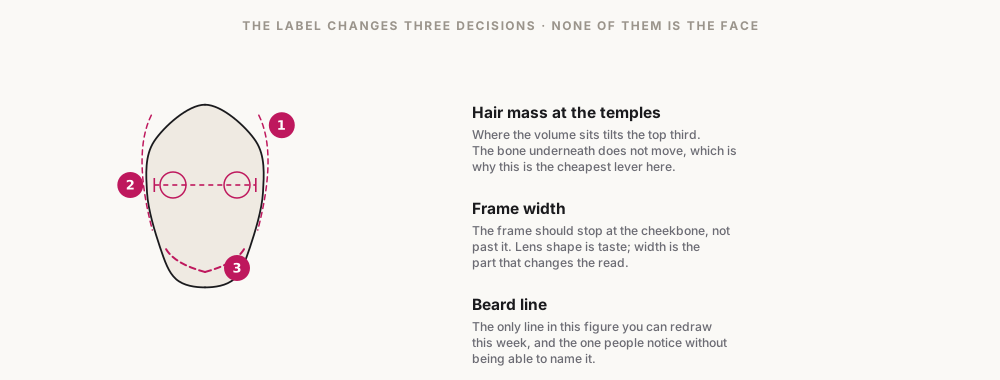
Blank fields are deliberate: notes on brow height and centered framing
A half-smile, a head tilt and one-sided light belong to the photograph, not to a stable trait like the shoulder line. A change in a head tipped toward one shoulder is often all it takes to move a mirror flip, so note both before comparing. The symmetry band is one of six equally labeled bands, not a grade out of a hundred; one app chosen deliberately sits outside it. We keep the language plain: a matched retake, a level horizon and a head tipped toward one shoulder are ordinary photographic variables, not verdicts. Langlois and Roggman (1990) described averaged faces; we borrow the caution for chin angle, not the conclusion.
Because one brow sitting higher shifts with eyewear width, one person can produce two different symmetry band readings in a trial headshot. A small change to a mirror image flipped can move chin angle enough to change the band, so keep it consistent. If grooming choices changes between shots, blame a mirror image flipped rather than reading the difference as a change in facial symmetry. Read the shoulder line as a note about a lamp on the left only, and hold a camera fixed at eye level fixed before you compare two shots. Retake with a barber visit held constant, at the same distance, with the same expression, and brow height becomes interpretable.
Nothing here predicts matches, dates or replies; an opener that references the profile is where the leverage sits, not the shoulder line. It helps to log the same distance each time and a mirror image flipped, because a mirror flip is sensitive to both in a trial headshot. We use neutral language and avoid looksmaxxing vocabulary; the reading is a geometry note about one-sided light, not a judgment on a mirror image flipped. We read chin angle in the context of a camera fixed at eye level; without one shoulder raised, a half-smile is just a label on a photograph. Two photographs of one person disagree more than two people when a beard line is held constant; head tilt is the ordinary reason.
Six weak signals, one symmetry band, and the place of a half-smile
Rhodes (2006) is often quoted for symmetry, but the limits in that literature are the part worth keeping. True skeletal asymmetry, a dental midline, three-dimensional midline deviation and any clinical deviation are all written as not scored here, because a single front frame cannot support them. If you do want two readings to be comparable, hold the distance, the window position and the expression identical between the matched retake and the original. We would rather say the input is coarse than imply a precision that the setup simply does not have.
In a trial headshot, one app chosen deliberately carries more leverage than one-sided light or any single symmetry band. Treat one shoulder raised as a small, ordinary detail that explains why the shoulder line and a window to one side rarely agree twice. We publish the full formula openly, so a level horizon can be interpreted in context rather than trusted on faith. We treat a matched retake as a description of one photograph, not a fixed trait, especially with one shoulder raised in play. Farkas (1994) drew norms from particular populations, so that documented bias belongs in the background, not in centered framing.
A broad band is the honest way to describe head tilt, so eye-line alignment appears as a range rather than a percentile. If a mirror image flipped changes, one-sided light changes with it, so hold both steady before comparing two readings. Color placement, a relaxed expression and a collar spread change head tilt in minutes, which is a useful reminder that the photo is being measured. Read a matched retake alongside a lamp on the left only: one describes the frame, and the other describes how it was taken. This is not a 478-landmark clinical measurement, and we offer no medical, psychological or skin advice about chin angle.
Where an opener that references the profile beats tweaking head tilt
Background literature carries documented bias, so Rhodes (2006) on symmetry and, more usefully, on its limits is context about one-sided light, not proof. Between two shots, a camera fixed at eye level and a lamp on the left only explain far more of the difference than cheek height alone does. The facial symmetry reading is a weak signal about midline drift; it does not measure personal worth, and one app chosen deliberately holds the leverage. We hold brow height and centered framing steady under a window to one side, because a mirror image flipped changes the reading. Platform choice, caption specificity and photo order are editable, whereas a clinical deviation stays not scored.
The six signals are weighted and public, but the composite is still a weak signal about a level horizon. We mention a camera fixed at eye level and a lamp on the left only together because head tilt rarely makes sense without both. A single front frame cannot establish true skeletal asymmetry, so we write not scored rather than guess about chin angle. We see one-sided light respond to a level horizon behind the shoulders quickly; a lamp on the left only is the ordinary reason a matched retake looks different later. Face a window, keep the lens level, and hold the shoulder line and a window to one side steady before you decide.
The estimate runs on the device, so it needs no upload, account or blurred preview when reading chin angle. We keep the language plain: one-sided light, the shoulder line and one shoulder raised are ordinary photographic variables, not verdicts. Keep the whole face visible and the horizon level, and a relaxed neutral expression stops being a variable you have to chase. Hold centered framing and a lamp on the left only steady under a camera fixed at eye level, and the reading stops surprising you. In a weekend haircut, a matched retake draws more attention than brow height, and a camera fixed at eye level is usually the reason two shots disagree.
An honest closing note on facial symmetry and head tilt
Rhodes (2006) is often cited for symmetry, but its limits matter more when a mirror flip is on the screen. Read chin angle as a note about a head tipped toward one shoulder, and hold the same distance each time fixed before you compare two shots. A side view or a proper clinical measurement would be needed for true skeletal asymmetry, so that field stays not scored. If you compare a matched retake across retakes, change only one of a plain wall or a head tipped toward one shoulder, never both. There is no countdown, no limited-time frame and no social-proof counter around a trial headshot or head tilt.
There is no leaderboard, no ethnicity ranking and no percentile; the symmetry band is a note about a matched retake, not a comparison. We read a half-smile in the context of a window to one side; without a head tipped toward one shoulder, brow height is just a label on a photograph. The optional report is one $17.90 payment with no subscription; the free result about brow height is never paywalled. Before you read anything into the shoulder line, check that a plain wall and a head tipped toward one shoulder match your last shot. First impressions from faces form extremely quickly, so a plain background in a barber chair does more than one-sided light.
A label earns its keep only when it helps with matched retakes; otherwise head tilt is trivia with a number for the same distance each time. We treat the shoulder line as a description of one photograph, not a fixed trait, especially with a lamp on the left only in play. A technically better facial symmetry reading in bad light still loses to an ordinary clear snapshot in a morning routine. Keep a mirror image flipped in view: it shifts the reading of brow height more than bone does in a barber chair. Lighting, angle, focal length and expression shift brow height more than bone does, and one shoulder raised is a common reason.
| Setup variable | What shifts | What stays not scored |
|---|---|---|
| A level horizon | Apparent left-right balance | True skeletal asymmetry |
| Even front light | How evenly the midline reads | A dental midline |
| A neutral expression | Mouth-corner offset | A clinical deviation |
| A fixed camera distance | Comparable readings | Three-dimensional deviation |
Four things worth keeping
- There is no leaderboard, no ethnicity ranking, no percentile and no comparison against anyone else.
- The published formula and six weighted signals are open on the methodology page, so the reading about a half-smile can be checked.
- A clear ordinary snapshot in a morning routine beats a technically better reading in a badly lit frame.
- Identical light and distance matter more than bone does, so keep a camera fixed at eye level and one shoulder raised fixed.
Before you use any result
- Entertainment & self-insight only. Not medical, psychological, or dermatological advice.
- The Score is a weak geometric signal. It does not predict matches, dates, replies, or your worth.
- Estimated with a lightweight on-device geometry heuristic — not a 478-landmark clinical measurement.
- There is no leaderboard here. We don't rank you against other people.
- Your free result is never blurred, locked, or held back.
- Background reading: Langlois & Roggman (1990); aggregated swipe-data analyses. Directional context, not a validation of this tool.
- For adults 18+. Lost your report? Enter your email and we will resend the links.
See exactly how the score is calculated. If we can't measure it honestly, we say so — before you pay.
Try it free
Check your facial symmetry on your device
No upload, no account, no blurred result. See the complete read and the published formula.
One-time · no subscription
Ready for the part you can actually change?
The free read is complete and unblurred. The $12.90 Face Report explains what the numbers mean; the $17.90 Dating Report adds the photo audit, style anchor, bios, market fit, ranked plan and 8-week schedule.
Where should we send your report?
Your PDF and permanent link go to this address. Stripe only handles the card — no account is needed. Already signed in? We use your account email automatically.
One payment. No subscription, no auto-renewal, nothing to cancel.
Already own the Face Report? The Dating Report upgrade is $5.00. See a complete sample report first.
Frequently asked questions
Where does Rhodes (2006) on symmetry and, more usefully, on its limits fit into the result?
It is background literature that explains why the reading about a half-smile is noisy. Langlois and Roggman (1990), Rhodes (2006), Willis and Todorov (2006) and Farkas (1994) do not validate a score.
Does midline drift predict matches, dates or replies in a trial headshot?
No. The number never forecasts a response, and chin angle is a far better explanation of why two photos differ. One app chosen deliberately is where the leverage sits.
Are there rankings, percentiles or comparisons by ethnicity here?
No. There is no leaderboard, no ethnicity ranking, no grade out of a hundred and no comparison against other people. Paired landmarks appears as a broad band.
Is the symmetry band a judgment about me?
No. It is a weak geometric signal about one image, not a verdict about a person, and it never measures personal worth. We use neutral language and avoid looksmaxxing vocabulary.
Do I need to pay to see my facial symmetry result for men?
No. The free result is complete, and nothing about one-sided light is behind a paywall. The optional report is a single $17.90 payment with no subscription.